
Impact Report, February 2026
Martha Depew began as an intern with JFA in July 2025 and is continuing her internship this spring. In this Impact report, Martha gives a window into her work through one special conversation she had recently, and she shares a principle that is helpful to all Christians as they seek to change hearts and minds. In addition, the tools Martha used here to help Becky are not hard to learn, and they can make a big difference for people who characterize themselves as “personally pro-life” and don’t want to “push their views” on other people through the law. Following Martha’s reflection, please take note of the partial list of recent and upcoming outreach events. Thank you for your support of our work through prayer and giving.
-Steve Wagner, Executive Director
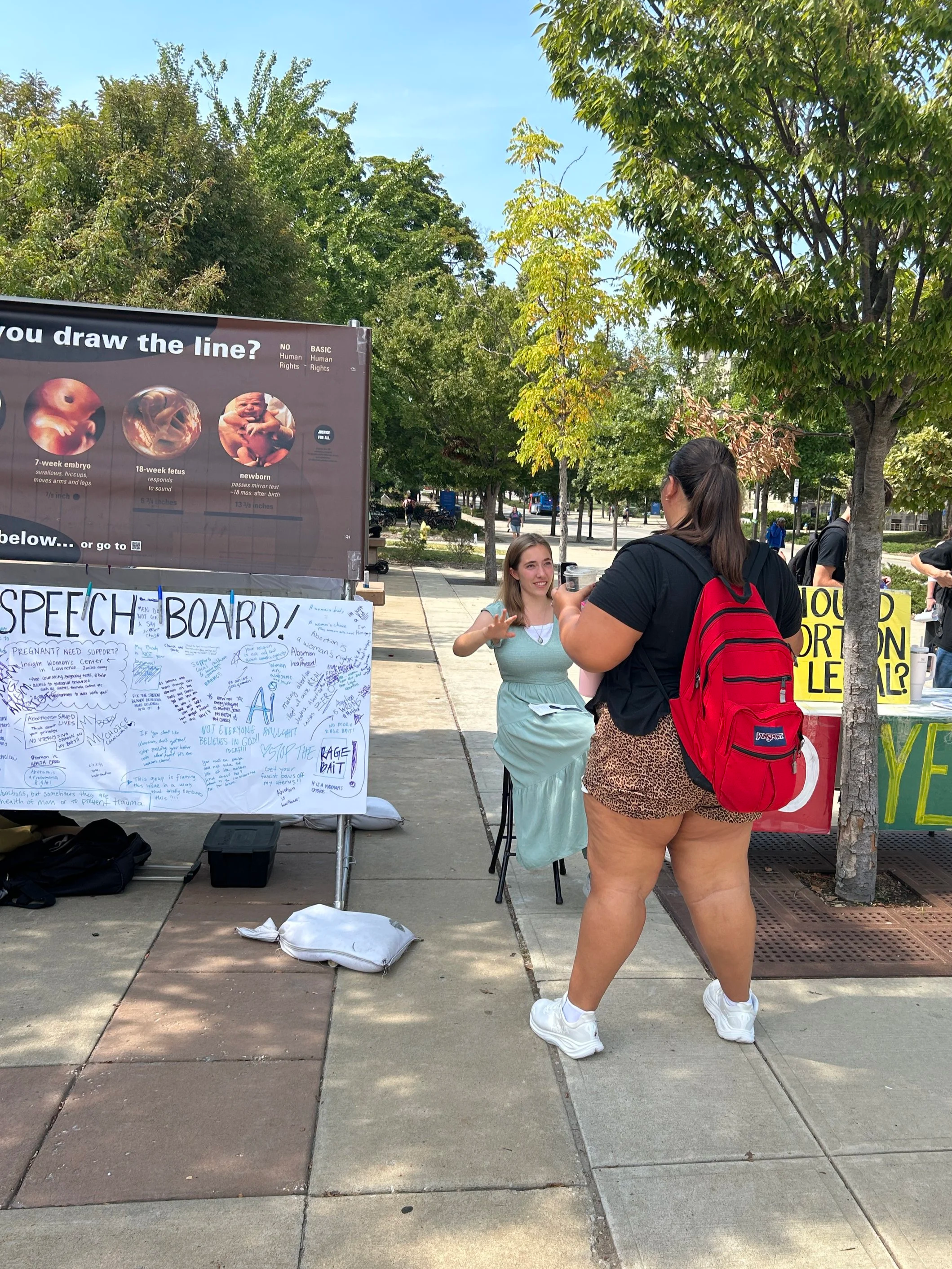
University of Kansas (Sept. 2025)
During my internship I have had many amazing opportunities to conduct outreach and help with Justice For All’s interactive workshops in Colorado, Arkansas, Ohio, Pennsylvania, Illinois, Missouri, Kansas, and Texas.
I’ve also spent time learning to give sections of our training and furthering my knowledge of the abortion issue.
I wanted to share a conversation I had at Colorado State University that was such a great reminder to me of how God might use one person to plant a seed and another person to water it.
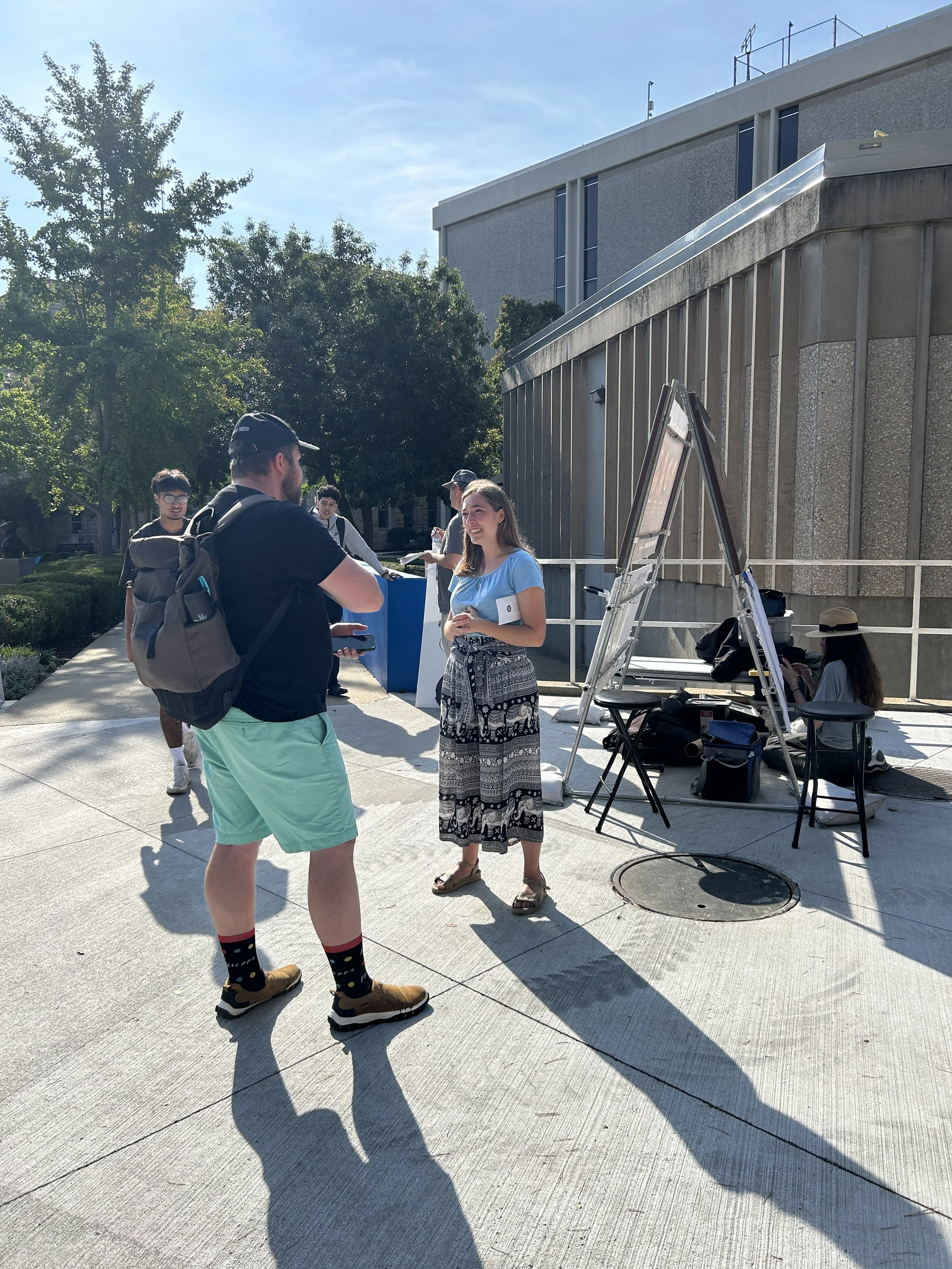
University of Missouri in Kansas City (Sept. 2025)
I asked a student I’ll call “Becky” what she thought of our display. She explained she had actually talked with one of our volunteers the previous day. She said that prior to that conversation she had been pro-choice, but at its conclusion she had significantly shifted her position to being “personally pro-life.” She meant that she was morally opposed to abortion, but felt uncomfortable saying that it should be illegal for others. I began by empathizing with her concern. I agreed with her that there are certain things to which I am morally opposed, but which I still think should be legal. For example, I said that while I believe that it is morally wrong to take God’s name in vain, I think the U.S. government would be overstepping if it started arresting people for this. After finding common ground with Becky, I then moved on to gently challenge her position. I pointed out that while there are some things we both agree the government should not regulate, there are other things in which the goverment has a duty to intervene, such as when an innocent person is being threatened with harm. We brought up various examples and discussed when the government should and shouldn’t intervene and into which category the abortion issue falls. At one point in our conversation I brought up the example of slavery. I helped Becky see the parallel to someone who said a similar thing about slavery when it was legal: “I am personally against slavery, but I don’t want to ‘force’ my view on others by saying it’s wrong for my neighbor to own slaves.” (I was very careful in framing this so that Becky would not feel like I was accusing her of anything, but instead simply drawing out the flaw in her way of thinking through an analogy.) Becky seemed struck by my analogy and was honest enough to admit the sense in it. I also used the example of being morally and personally against child abuse but not wanting to “impose” that view on others.
Becky had already become convinced the day before that abortion hurts an innocent child, so at this point in the conversation she had to admit that she agreed with me. Yet, I could tell that there was still something stopping her from fully shifting from only personally thinking that abortion is bad to thinking it should be illegal for other people. We had been talking for a while and built a lot of rapport, so I felt that I could be pretty direct with her. I asked her if the reason that she couldn’t bring herself to become fully pro-life was because she was scared to hold such an unpopular opinion. Becky frankly admitted that this was how she felt. It is an understandable fear because holding the opinion that abortion should be illegal, especially at a secular university, would practically guarantee losing friends. For someone like Becky who had probably grown up with the idea that being pro‑choice was essentially tantamount to being a compassionate, reasonable person who cares about human rights, it’s so difficult and requires a lot of bravery to recognize the truth about the humanity of the unborn. I was honestly impressed that she was even willing to consider something that would push her so far out of her comfort zone and belief system. At the close of our conversation I encouraged Becky that if she truly believed that abortion takes an innocent life then she must take a stand in defending unborn children, even if it is unpopular. Becky concluded by saying that she needed to think about it all more, but she seemed pretty convicted.
At Justice For All we talk about planting a seed, but this was the first time that I got to see so clearly firsthand how each conversation can be one step in someone’s journey. Because our volunteer had covered so much ground with her the day before, I was able to focus more specifically on helping her see that if abortion ends an innocent life, then it is not a subjective matter that should be left up to each person to decide, but an objective injustice against which we must take a stand. I’m so grateful that God allowed me to witness the growth in Becky.
Martha Depew, for the JFA Team