
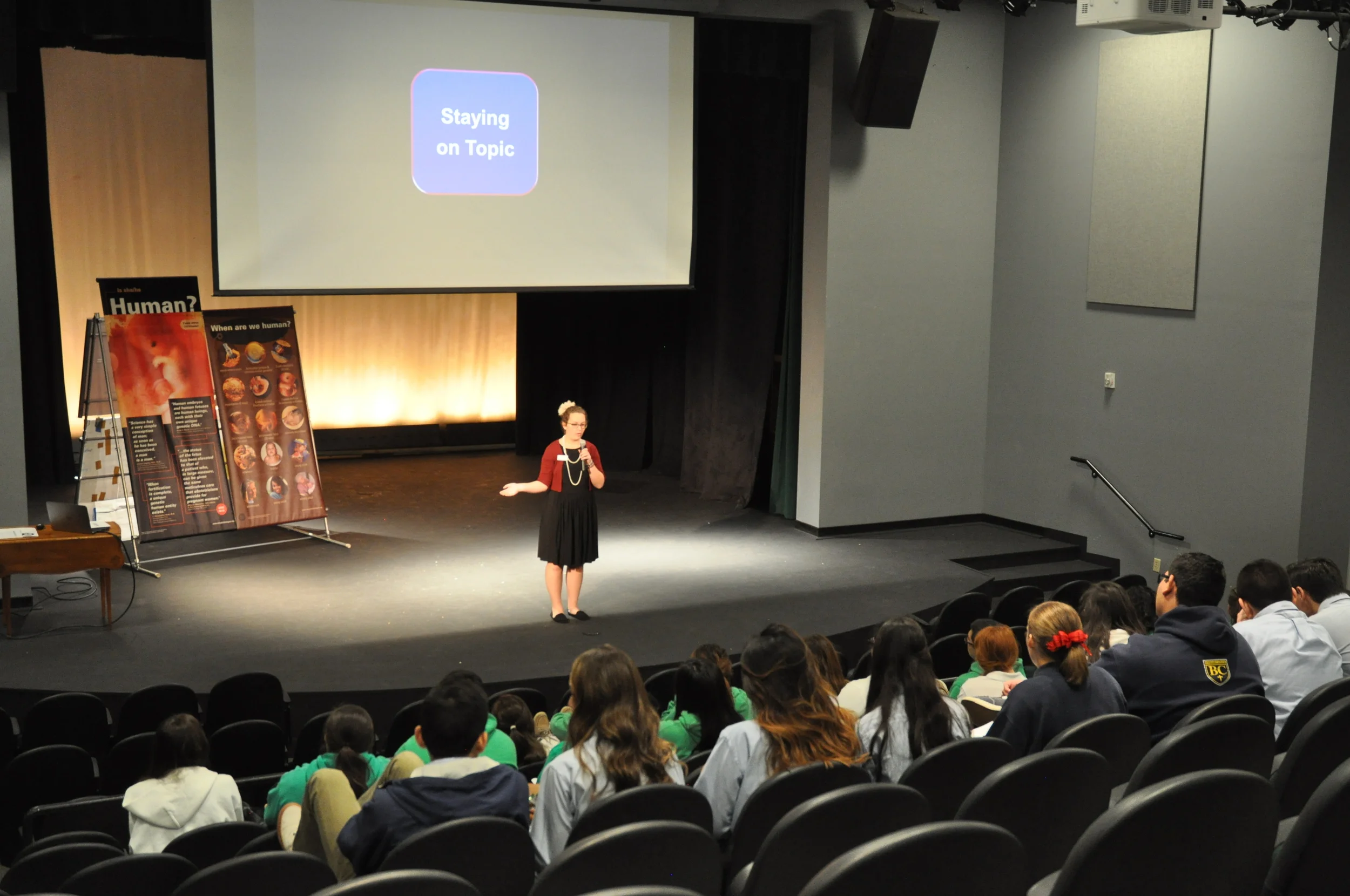
Refocusing the conversation on the question, “What is the unborn?”
I hear a lot of justifications for abortion. Sometimes I think, “Yes! This is exactly what we need to talk about in order to resolve our main difference on this issue!” Other times I think, “No! This is not going to help solve our core disagreement about abortion!”
“We can’t answer this question, “Can I kill
this?” until we know what “it” is”
What do I mean? I’ll explain by adapting a story from Greg Koukl at Stand to Reason). As many of you know, I come from a large family. The number of nieces and nephews I have is growing, and because of this, when my family has dinner together, the number of dishes in the sink is exponentially greater than in previous years.
Let’s imagine that I’m at the sink cleaning the dishes when my nephew comes up from behind me and asks, “Aunt CK, can I kill this?” My back is towards him, so of course the first question out of my mouth is, “What is it?” If I turn around and see his hands outstretched and holding a bug, my reaction will be much different than if I turn around and see him with one of his cousins in a headlock. I may be okay with him killing a bug, but I would not be okay with him killing another human being. In fact, I would probably suggest that it’s time for counseling.
When it comes to the topic of abortion, most people will agree that abortion kills something, but what is being killed? Is abortion just a “surgical procedure to remove cells”, or does it kill a human being? You see, we can’t answer this question, “Can I kill this?” until we know what “it” is.
If someone tries to explain why abortion should remain legal by arguing that the unborn is not a valuable human being, at least we’re “on topic.” In other words, we’re focused on the central question, “What is the unborn?” and we can discuss whether or not the unborn is the same kind of thing as you and I. If it is the same kind of thing, it should therefore be treated equally to the rest of us.
In February, I taught students in Arizona how to refocus a conversation about abortion onto the central question of “What is the unborn? The next week, these students participated in an outreach event at ASU. Not only was the weather gorgeous, but we met some wonderful people and had thought-provoking conversations.
Some of the other reasons people give for their pro-choice views, however, do not address that central question at all. Instead, these reasons assume that the unborn is not a valuable human being and that circumstances determine whether or not abortion is right or wrong.
When someone brings up a justification for abortion that does not address the question, “What is the unborn?” it is important to help him see that we must answer this question before we can move forward in our conversation. We must discuss what the unborn is because this is where our core disagreement lies. One conversational tool that helps people understand this more clearly is called “Trot Out the Toddler (TOTT)” from Scott Klusendorf of The Life Training Institute).
For example, earlier this month when “Rick”, a student at Arizona State University (ASU), claimed we need abortion because of overpopulation, I addressed this by using the four steps of TOTT that we teach in our Abortion: From Debate to Dialogue seminar: Agree, Apply, Ask Why, and Ah! Here is how I “Trotted Out the Toddler” in our conversation:
Rick: I just think that the world is overpopulated and that we need abortion to keep our population under control.
Me: I would agree that there are some parts of the world, like some cities in China, that are extremely overpopulated. Can we agree that we want people to be in healthy environments and have enough resources? [Acknowledge some aspect of Rick’s concern with which I can agree.]
Rick: Of course.
Me: So we are definitely on the same page about that. Let me ask you a question that doesn’t have to do with abortion. This example should also be something that is really clear to the both of us and I think it will help us in this conversation.
Rick: Okay.
Me: Let’s say that there is an orphanage of a thousand two-year-olds in one of those densely populated areas of China. The orphans don’t really have a healthy environment and resources are limited. Would you say that it would be right to kill these orphaned two-year-olds because of overpopulation? [Apply the situation raised to a toddler.]
Rick: No way!
Me: I agree with you. Why do you think it’s so clear that we can’t we kill a thousand two-year-olds? [Ask, “Why?” until Rick reveals that it’s wrong to kill two-year-olds because they are human beings.]
Rick: That’s mass murder! They are human beings.
Me: Ah! So, would you agree then, that if the unborn is a human being like a two-year-old, then it would be wrong to kill him even if the world is overpopulated? [The “Ah!” step of a conversation helps Rick see for himself that we must first address this question of “What is the unborn?” before we can move on in the conversation.]
Rick: I see what you are saying, but I don’t think the unborn is like a two-year-old.
Me: I see. Do you agree, though, that that’s the central question we need to resolve?
Rick: Sure.
And, suddenly, we were back on the topic of “What is the unborn?” Now the conversation could move forward and we could discuss more about our core disagreement. “Trot Out the Toddler” is one of my favorite conversational tools to both teach and use in dialogue. It is very helpful for ensuring that both I and the person I am talking with recognize what things we agree on, as well as what things still need to be discussed.
The way I’ve communicated this concept here has been heavily influenced by Justice For All’s Abortion: From Debate to Dialogue seminar. If you are able, I would love for you to attend a seminar and learn more!