
one central question

A Charge to Continue

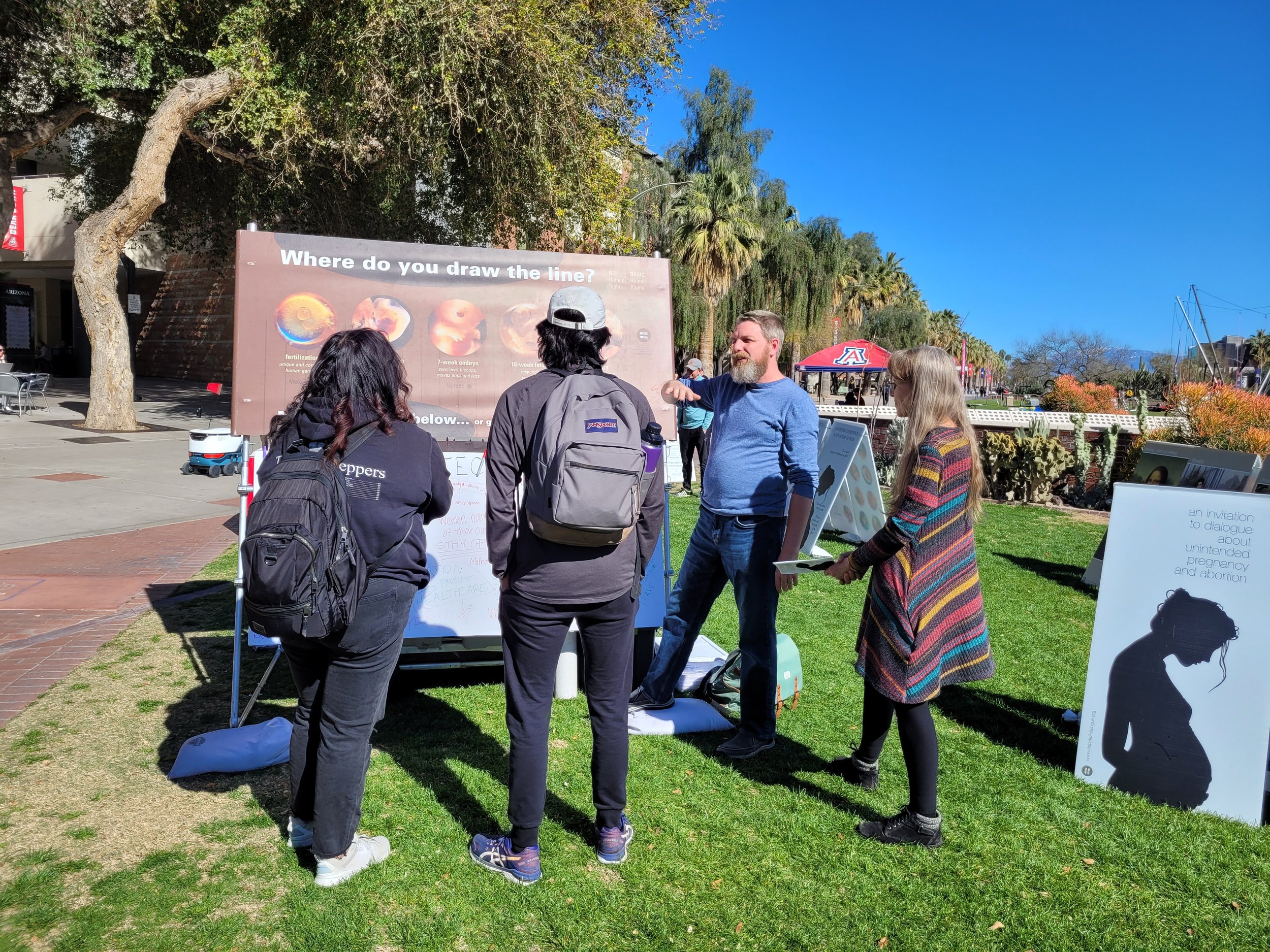
I was at the University of Kansas talking to students when I started to receive notifications that Charlie Kirk had been shot. As we continued outreach that day, it was sobering to think that Charlie had been shot for speaking the truth.
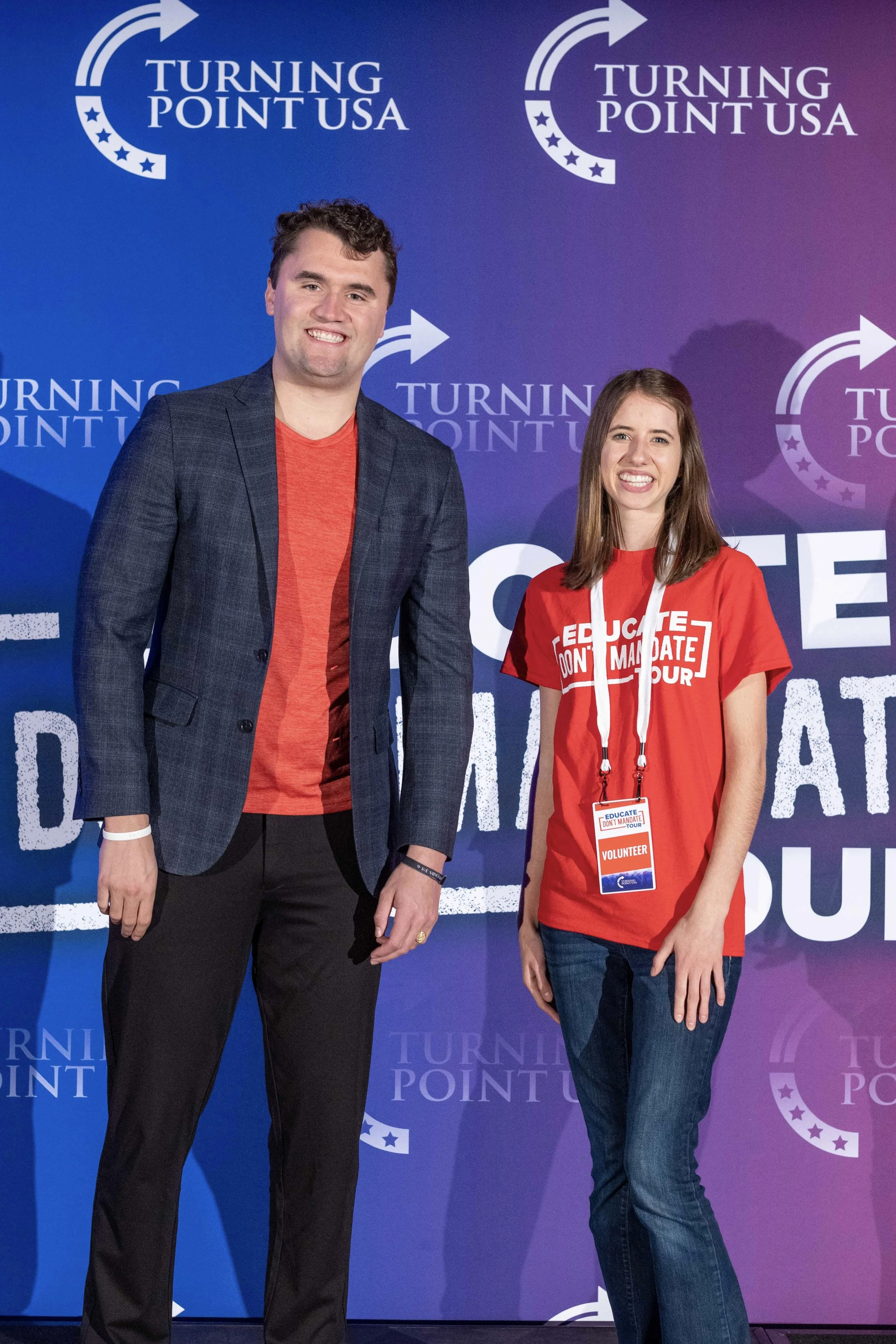
I had the privilege of meeting Charlie in March of 2022.

The assassination left many Christians grieving and wondering what is next. Charlie was a man of courage and boldness, and he loved the Lord and our country. His faith was inspiring. His love for his family was touching. His determination to spread the gospel was convicting. America lost a true hero.

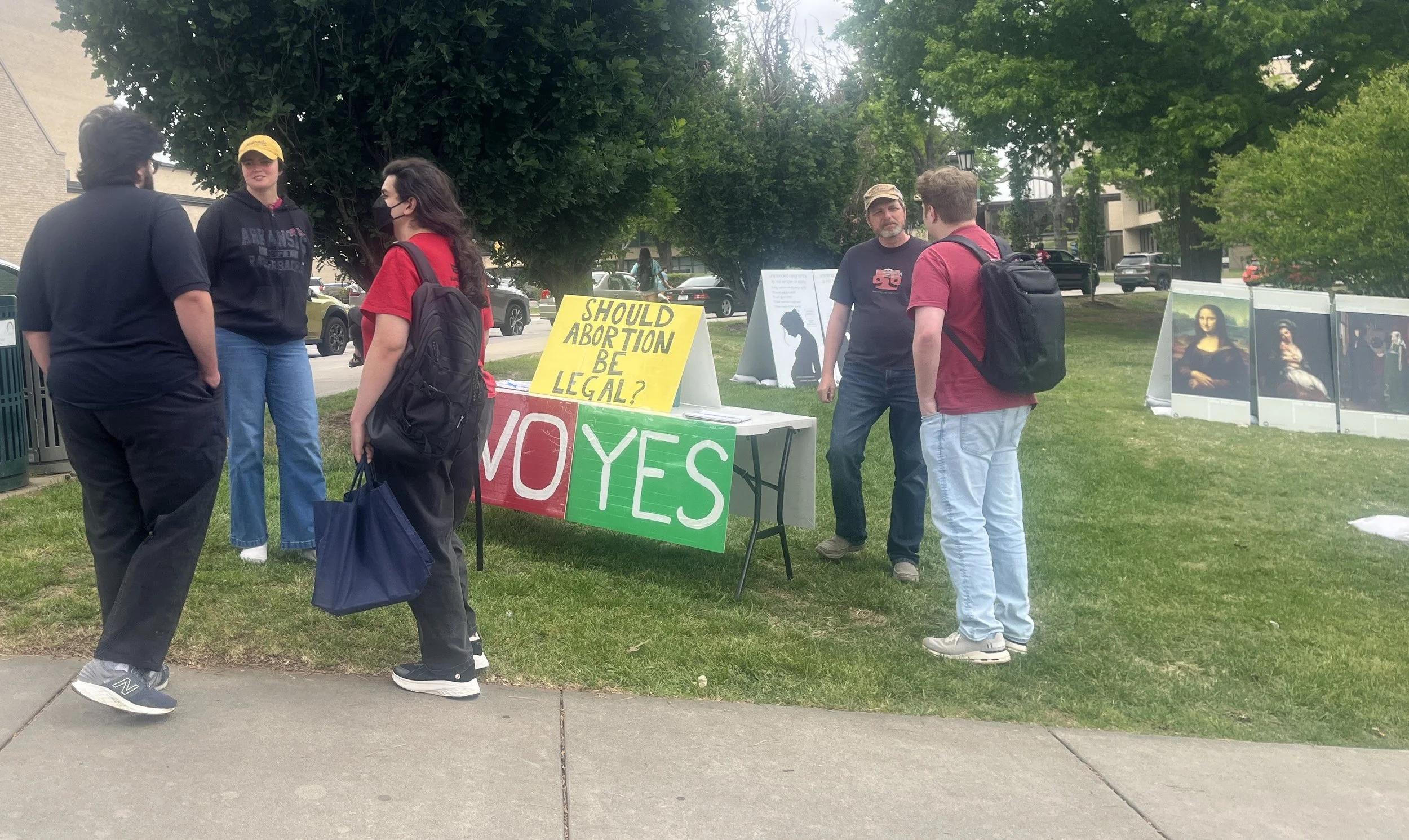
Just a few days after Charlie Kirk was murdered, I went to the University of Arkansas to lead an outreach event. A student I’ll call “Tim” walked up to the poll table and signed “Yes” to the question, “Should abortion be legal?” I asked Tim if he had time to share more of his thoughts. This is how our conversation went.

Tim: I believe women should have choices. I think women should be able to choose if they want an abortion or not.

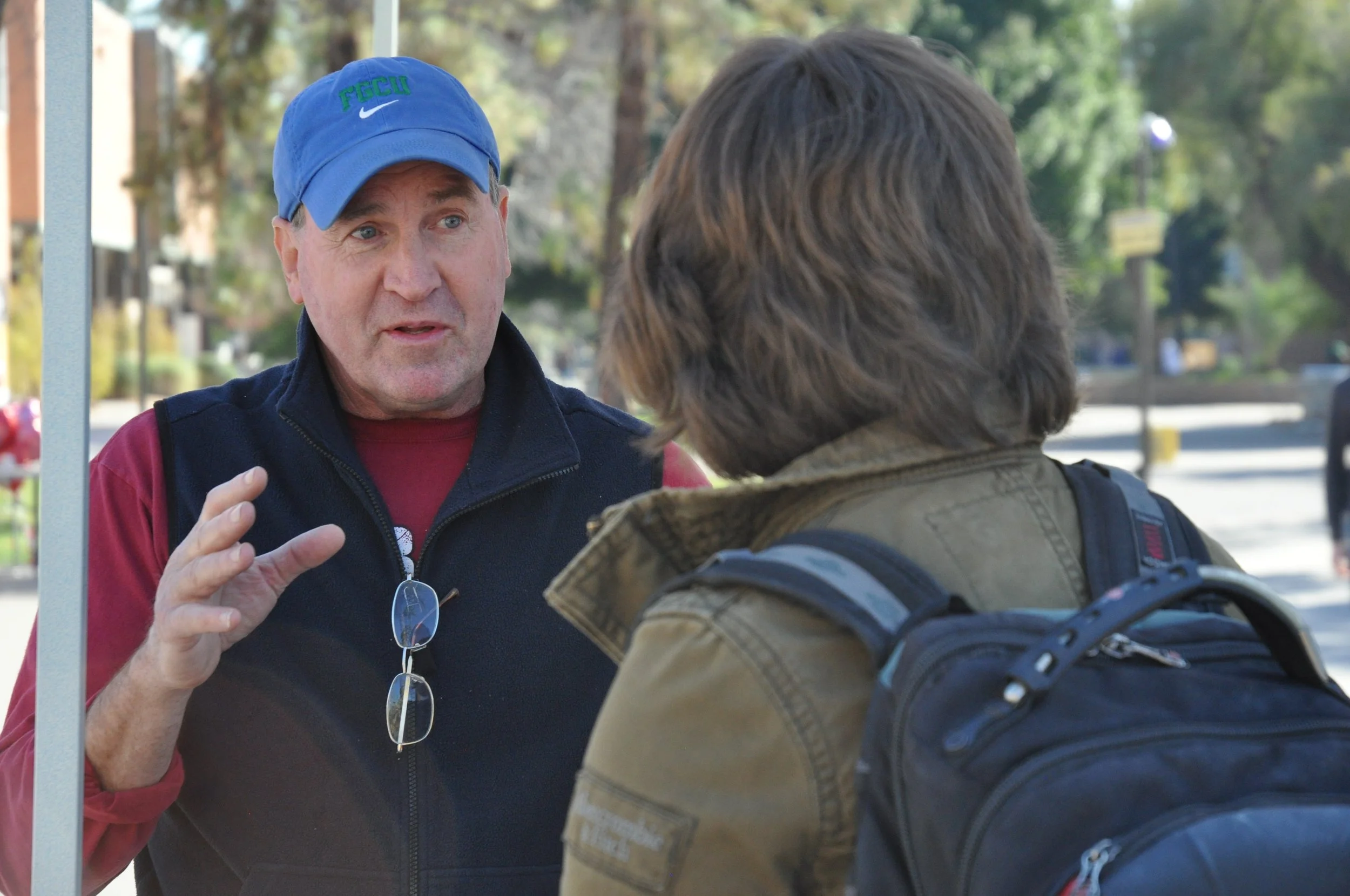
Five volunteers participated in outreach at the University of Arkansas in September of 2025. 

Andrea: I agree with you that choice is super important. We should all be able to make choices for ourselves as long as that choice does not harm other human beings. Murder, rape, and child abuse are wrong because those choices harm human beings.

Tim: That is true.

As I began asking Tim about his beliefs, he shared that he believed abortion should be legal for circumstances such as rape and poverty and for a certain duration of pregnancy, but not for all nine months.

Andrea: Yes. Those are hard circumstances for sure. Rape is a horrific crime. Poverty is a difficult situation as well. If a woman feels like she can’t provide for her baby, that is so stressful.

Tim: Yes, definitely.

Andrea: I have a hypothetical situation that I want to bring up. Let’s imagine that there is a mother with a two-year-old that is in a situation where she can’t afford to care for her toddler. Would it be okay for the mother to end the life of her toddler if she feels like that would help her situation?

Tim: No, of course not.

Andrea: I agree with you. This is probably an obvious question, but why can’t that mother kill her child?

Tim: That would be wrong. That toddler is already born and alive.

Andrea: Yes, that toddler is alive, and it is wrong to kill human beings. If the unborn are human beings like the toddler, then should we protect the unborn like we would the toddler?

Tim: Yes, if the unborn are human beings, then they need to be protected, too.

I asked Tim when he believed life began scientifically speaking. He was not sure, so I shared what biology teaches on this question. We discussed the fact that life begins at conception and that the unborn is a living human being that is growing and developing over time.

Tim: Wow! That makes sense. That cleared up a lot of things for me. I am on the fence with this issue. I can see both sides of the argument. I now see that the unborn is a human being, but some women are in challenging situations.

We found common ground about how important it is to care for women in difficult circumstances. Then I asked Tim if he was open to seeing images of abortion, and he said yes.

Tim: Wow. That is horrible.

Andrea: I agree. Do you think abortion is a medical procedure or does an abortion take a life?

Tim: I would say both. Abortion is taking a life, but it is also a medical procedure.

Andrea: Well the purpose of a medical procedure is to promote life, like heart surgery or removing a tumor. Abortion takes a human life.

Tim: That is true. I think women should have a choice, but I am realizing that a woman should not have the choice to kill her unborn baby.

It was energizing to be on campus that day as I spoke with many pro-life students and open-minded pro-choice students. While there is so much darkness in the world, God is moving.

As I have been reflecting on the assassination of Charlie Kirk, I am reminded that God is all-powerful and can use each one of us to impact the world. I believe the reason the world was so impacted by Charlie’s life was because He gave it to the Lord. He told the Lord, “Here I am, send me.” God has called each of us to serve Him in our unique corner of the world. That will look different for each person, but being faithful to serve the Lord where He calls us is what matters.

1 Thessalonians 2:11-12 says, “you know how we exhorted, and comforted, and charged every one of you, as a father does his own children, that you would walk worthy of God who calls you into His own kingdom and glory.” May we be comforted in the Lord and charged to live a surrendered and courageous life.

Thank you for your love and support toward my work with JFA. I appreciate each of you very much.

In Christ,

Andrea

But What Is It?

But what is it? That’s the question that very rarely gets asked or answered.

I watched the portion of the debate between the vice presidential candidates that focused on abortion (pictured). That question kept ringing in my head, but it didn’t really get any time in the segment. True, JD Vance tried to get clarification on one “what is it?” question, related to the Minnesota abortion law: “What specifically does the Minnesota abortion law allow and not allow?” Indeed, it would have been nice to get a clear answer to that question. If we had, we’d have also gotten close to the edge of the question, “What is it?” related to abortion itself.

If the segment had led to the question, “What is abortion?” it would have been illuminating. Indeed, if we spent more time considering what abortion is itself, it would inevitably lead to the most important “What is it?” question: “What is the unborn?”

That question, “What is the unborn?” is the one that rings in my head throughout any exchange on abortion rights or women’s rights or bodily rights. It’s the first question we have to resolve in order to get any clarity about the others. True, the questions of a woman’s bodily rights or life-threatening pregnancy complications or what a just law would be on abortion are all important questions. But we can’t answer them without addressing this first central question: “But what is it?” Meaning, “What is the unborn?”

So, let’s say I’ve convinced you, and this question is now ringing in your head. Perhaps for you it’s even like a knee-jerk reaction every time the topic of abortion is discussed, as it is for me. But what do we do with this knee-jerk reaction? Do we insert that question robotically, as if it’s the first and only item on a meeting agenda? That won’t do. To win the right to bring clarity to the importance of this one question, our team has found that saying two other words many times and early in a conversation can sometimes make all the difference. What two words? “I agree.”

Find common ground about difficult circumstances confronting pregnant women. Find common ground about serious injustices violating a woman’s right to be free of sexual assault and other abuse. Find common ground about the difficulty confronting women who find themselves in a high-risk pregnancy situation.

We don’t only find common ground, though, and neglect to shed light on what is right and wrong about abortion. And that’s where our central question comes in: “But what is it? What is the unborn?”

So, here’s my suggestion: Remember the sentence, “I agree, but what is it?” Then use that as a structure for the conversation to remind you of these two important things to emphasize in the conversation. I’d spend a lot of time and energy on the first part, “I agree,” but I’d also work hard to not let the “but what is it?” question get lost.

So, when someone says, “women will die of pregnancy complications if abortion is illegal,” I’ll spend three to five minutes showing concern for those situations and agreeing that each woman is important in herself and not just as a talking point in a conversation. I’ll ask the other person if she agrees with what I’m saying. I’ll take time to discuss this. But then I’ll say, “It’s difficult to know which options to offer the woman, though, if I don’t even know how many people are in the hospital room with her. If the unborn is a human being, then that’s going to affect how we proceed in any life-threatening circumstance. Should she be able to get an abortion? Well, if the unborn is a human being, and abortion causes the death of that human being, then we would avoid abortion if at all possible in seeking to save her life.”

That’s the clarity that “but what is it?” brings to the conversation. I admit that it doesn’t answer all the questions about life-threatening circumstances. But it answers the first question, the central question that must be answered in order to make any progress on a solution.

So, the “what is the unborn?” question is like a gate on a roadway. You have to open the gate to pass.

Or, to put it in philosophical terms, it’s a necessary condition for getting to a practical solution. It’s not a sufficient condition - it’s not “all you need.” But it is a necessary condition - it’s “got to be there.”

Here’s another example: Walz emphasized in the debate that women need to control their bodies and make their own decisions.

I’m going to follow my strategy reminder I laid out in the sentence above: “I agree, but what is it?”

I’ll begin with three to five minutes of emphasizing how a woman’s right to be free from assault and other abuse is still important and still under grave attack all over the world. (I’m not talking here about how much time someone should spend on this in a debate, of course…I’m talking about the more common situation in which all of us find ourselves regularly, where the topic comes up and we have a choice of how to engage and for how long. In a formal debate, one could use the same strategy, but we would have to settle for putting it in soundbites.) I’ll emphasize my concern for safety of women and respect of women. At some point early in the conversation, though, I want to also make sure the unborn is not forgotten or invisible. I’ll ask some form of, “but what is it?” Is the unborn a human?

If we’re talking about whether a woman’s bodily rights entail killing the unborn through elective abortion, we’d better get an answer to the question, “What is the unborn?” I’m going to aim to spend an equal amount of time on this question, too: three to five minutes. (Again, in a formal debate we’d have to put these same ideas into soundbites.) I’ll aim to help the person with whom I’m speaking to see the unborn human with new clarity through images and arguments. (See the notes from session two and session three of our Love3 course for help on this.)

If the unborn is a real human being, as we can demonstrate that she is, then it doesn’t immediately tell us what to think about the right to abortion, but rather, it just clarifies that there are, in fact, two human beings in the picture, and each of these human beings, the woman and the unborn child, has an equal right to his or her body. Then we can move forward to consider whether the right to the body that the woman has means she can kill another human being located inside of her body, another human being who has a right to his body. In our work on bodily rights over many years, we’ve gone to great lengths to show that her right to her body does not entail the right to kill her unborn child. See our “It’s Her Body” series, which includes a 20-page response to the strongest version of the bodily rights argument for abortion.

So, remember this simple sentence to remind you of the strategy that will shed the most light in the least amount of time: “I agree, but what is it?” We find common ground because it’s true that the person is making good points, and it helps the person to want to hear the rest of our perspective. Then we move the conversation forward with some form of the question, “What is the unborn?” because that question is a necessary condition for answering the question, “Can I kill this?”

I’d like to mention that I owe this strategy to two of my mentors, Scott Klusendorf and Greg Koukl. I’ve probably heard both of these men say something very similar (or exactly similar) to the sentence, “I agree, but what is it?” many times in the past. I’ve been emphasizing it for the past 23 years. They’ve been emphasizing it even longer, since the late 1990s. For my part, I’ve been open to re-evaluating it or changing the emphasis or abandoning it. But it has stood the test of time and experience. Our team has tested this question, and the strategy I outline above, combining it with common ground, in thousands and thousands of conversations. It isn’t failsafe or foolproof. But it does bring the important first step of clarity to very complicated issues.

Without the question, “But what is it?” the conversation is mostly just slogans and noise. That’s not only a sad waste of time. It’s deadly, because the unborn child continues to be the last thing on everyone’s mind. Let’s change that. Let’s say, “I agree, but what is it?” and put the unborn back where they belong, right in the middle of the conversation about women’s rights and just laws.

Aha Moments for Henry

Impact Report, May 2024

In this Impact Report, we feature a reflection from JFA trainer Andrea Thenhaus along with pictures of JFA trainers and volunteers at recent outreach events.  In early April, Andrea had a memorable conversation with Henry at Grand Valley State University near Grand Rapids, Michigan.  Although many people with whom we interact on campus don’t reveal their inner thought processes, Henry was kind enough to give Andrea a glimpse of how the conversation was changing him.  Aha moments are a joy to witness, but whatever the results seem on the surface, we thank God for helping us speak for those who cannot speak for themselves (Proverbs 31:8).  We thank God for you and for your partnership as we seek to be faithful in each conversation.

-Steve Wagner, Executive Director


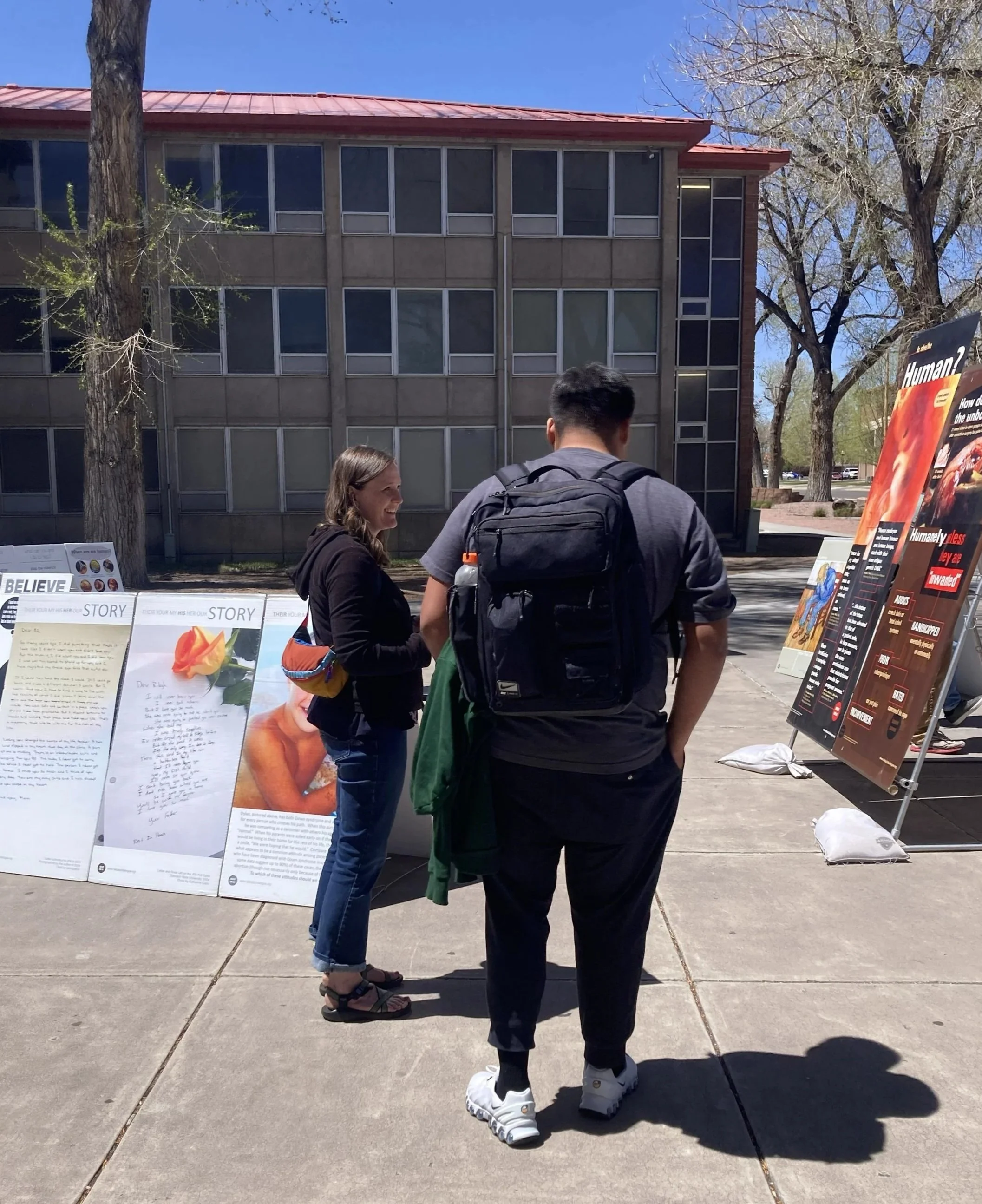
Andrea (center) and volunteer Kalen (left) at Adams State University in Colorado (April)

Our team was nearing the end of our second day of outreach at Grand Valley State University. While the team started taking everything down, I remained available for conversations.

About this time, a student I’ll call “Henry” walked by our exhibit. I asked him if he had time to share his thoughts on the issue of abortion.

Henry replied that he was on his way to class and could not talk. Then a minute later, he turned around and said, “Actually, I have a few minutes to talk.” Our conversation went something like this:

Andrea: Okay, awesome. Do you think abortion should be legal or illegal?

Henry: I think it should be legal mainly for cases like rape, health of the baby, and life of the mother.

Andrea: Those are all hard cases for sure. Rape is such a horrific thing. Even if the woman does not get pregnant, it is still a traumatic experience. Then if the woman gets pregnant, things get even more complicated.

Kaitlyn (sitting), Kristina (center), and Seth (right) at University of Cincinnati (March)

Rather than jumping right into challenging Henry on his viewpoint, I was taking the time to slow down and show compassion for people who have been raped. Pro-choice and pro-life people all agree that rape is horrific, and it is helpful to find that common ground in our conversations. After spending a few minutes meeting the relational challenge inherent in discussing the topic of rape by acknowledging how difficult that situation is, I went on to intellectually respond to the questions he raised.

Andrea: For these specific circumstances that you mentioned, do you think abortions should be legal for all nine months of pregnancy or for a certain period of time?

Henry: Definitely a certain period of time. I believe the unborn are living human beings, so abortion should be legal for only the first trimester.

Andrea: Okay. Do you know anyone who has been affected by rape?

Henry: No, I do not. I just know it happens.

Andrea: Yeah, for sure. Here’s one way I look at it. Imagine there are two women who have been violated through rape. Both women have gotten pregnant. One of the women has given birth to her son. He is two months old now. The other woman is two months pregnant. If I asked you if both women have the right to kill their child, I think you would say no.

Henry: Right! Of course the woman with the two-month-old should not be able to kill her child.

Steve and volunteer Kim (right) at University of Arizona (February)

Andrea: I totally agree. If the unborn are human beings like the two-month-old, then we should protect the unborn even if they came about through rape, right?

Henry: You made a good point there! That makes sense. And why should the unborn be punished for the wrong that was committed?

Andrea: I agree.

Henry: Abortion should only be legal for the health of the baby and the life of the mother.

I addressed these issues, and by the end of the discussion, Henry responded:

Henry: Wow! Those are good points. This has given me a lot to think about.

Before Henry left for class, he thanked me for the conversation. I could tell that God was working in his life. Henry realized that since the unborn are living human beings, they should be protected even if they may not live very long or if they were conceived through rape.

Our trainers and volunteers often have opportunities to gently challenge pro-choice students and point out the inconsistencies in their views by asking them questions that help them think through the issue themselves. Thank you for your prayers and support that allow us to have conversations with students like Henry.


When Compassion Kills

This past June, I sat on Wichita State University’s campus next to a poll table with the question, “Should Abortion Remain Legal?” I encouraged a young woman, Michelle, to share her opinion as she walked past. She responded,

Abortion needs to be legal for women who are not able to care for or provide a good life for the child. So many children live in broken homes, are abused, and experience neglect. Abortion is a better option in this situation because it prevents a child from ever having to live through these experiences.

I didn’t agree with her conclusion—that abortion should remain legal—and yet, there was something about Michelle’s explanation with which I could agree. There was also something about her demeanor that stood out to me. I made a mental note of both, knowing I would bring them up later in the conversation.

Since we had begun talking only a few minutes earlier, instead of jumping to conclusions about her beliefs, I decided to ask a few more questions to fully discover her position regarding the legality of abortion.

About 15 minutes later I turned the conversation back to her concerns about children living in difficult circumstances—and whether or not abortion is an acceptable way to prevent future abuse, neglect, and broken homes. The conversation went something like this:

Me: Michelle, earlier in our conversation you mentioned that you believe abortion is necessary, especially in situations where a woman wouldn’t be able to adequately care for the child.

Michelle: [nodding her head] Yes.

Me: I want to acknowledge something about you that I appreciate. From our conversation so far, I can see that you truly care about women and you care about children. You desire good for them. It is refreshing to meet students on campus who are not apathetic but instead have compassion.

Michelle: [smiling] Thank you.

Me: You’re welcome. I, too, desire for women and children to live prosperous lives, to be loved, and to live in situations free from abuse, poverty, and neglect. We have that in common.

Do you mind if I ask you a question that is not about the unborn? I will come back and reference them in a moment, though.

Michelle: No, I don’t mind. Go ahead.

Me: Let’s imagine that there is a woman in a difficult situation who isn’t able to care for her child. This woman’s child is two years old. Her husband had always been the breadwinner for the family, and she had stayed at home to care for her child. Sadly, he died in an accident and didn’t have life insurance. Now she isn’t able to find work, and she doesn’t have help from family or friends. Now, I’m going to ask a question that may sound a little crazy, but we’re likely to agree about the answer: If this woman isn’t able to provide for her child, should she have the right to kill her two-year-old as a solution to their problem?

Michelle: No, of course not.

Me: I agree. This next question may also seem extreme, so please bear with me for a moment: Why? Why can’t she kill her two-year-old child?

Michelle: Well, of course because you can’t kill children! They are human beings. [Michelle immediately recognized one can’t kill the two-year-old because he is a human being. Many people say that you can’t kill the two-year old because “it’s wrong” or “it’s illegal.” For this type of person, it takes longer than it took for Michelle to get to the more fundamental reason that you can’t kill the two-year old —“because he is a human.”]

Me: Once again, we’re on the same page. Let’s think about that for a moment, though. We agree that not being able to care for a child is not a good reason to the kill the child. And we agree that it would be wrong to kill the two-year-old because he is a human being. So, can we agree that if the unborn is a human being like the two-year-old, we would have to protect the unborn like we would protect the two-year-old?

Michelle: [silent pause] Wow, I haven’t ever looked at it that way before.

It was clear from her change in demeanor that Michelle was connecting the dots between her view that the unborn was human and how we should treat the unborn. But it appeared to me that she now saw her view in conflict with her concern for the condition in which these women and children would be living, so I addressed that.

Me: Michelle, as I mentioned earlier, you seem to have a strong desire to show people compassion. Your personality and demeanor make that obvious. I see this desire as a good thing. I admire people who are compassionate. It may be helpful, though, for us to discuss compassion a little more. When you see people in pain or suffering, do you desire to help them and relieve them from experiencing this suffering or pain?

Michelle: Yes, yes, of course.

Me: That’s a natural and good response, but we have to make sure that our methods of relief are truly compassionate. Can we agree that it isn’t always compassionate to encourage a friend to do anything she can think of to remove a difficulty, pain, or struggle from her life? For instance, let’s use the example of the mother with the two-year-old again. Can we agree that, even if killing her two-year-old would prevent her from living in poverty and prevent her child from living a hard life, it wouldn’t be compassionate to encourage her to kill her child? In order to be compassionate, we need to seek solutions that uphold the dignity of both the mother and the child, even if we can’t eliminate all of their pain and suffering.

During the past seven years I have had conversations with hundreds of students with pro-choice leanings. When I have taken the time to truly understand their positions regarding the legality of abortion and why they support these views, many times I’ve found that they hold their beliefs because they care about women. It is not because they dislike or hate the unborn. Often they have a deep care for children, too. They, however, like Michelle, come into the conversation believing that abortion is compassionate. Thank you for making it possible for me to propose a different kind of compassion to these students and to Michelle. Please say a prayer for Michelle, that the information she learned from our conversation will continue to bear fruit in her heart and mind.

-Rebecca Hotovy


This past June my roommate Catherine and I had the joy of hosting a seminar. It was the first seminar to take place in our own home! The invitation list was limited because of space, but we crammed 13 participants into our living room using a little creativity and the skills we learned from playing Tetris as children.

After the seminar, participants were given the option to write a “Thank You” to the financial supporters who had made the event possible. Today you are receiving a “Thank You” (to the left) written by a seminarian, Michael, who wrote that you have helped prepare him for what he had previously considered “an impossible task.”

—-

“Dear Justice For All Supporter,

I’ve always been pro-life, but how in the world do I share that message in a culture that isn’t?…an impossible task!

After attending [a] JFA seminar, the impossible finally feels attainable. I have practical, simple tools to engage someone in a productive dialogue on abortion. Thank you sooo much for providing support to make that possible! God is good!

-Michael

Let's Talk About the Same Thing

Refocusing the conversation on the question, “What is the unborn?”

I hear a lot of justifications for abortion. Sometimes I think, “Yes! This is exactly what we need to talk about in order to resolve our main difference on this issue!” Other times I think, “No! This is not going to help solve our core disagreement about abortion!”

We can’t answer this question, “Can I kill
this?” until we know what “it” is

What do I mean? I’ll explain by adapting a story from Greg Koukl at Stand to Reason). As many of you know, I come from a large family. The number of nieces and nephews I have is growing, and because of this, when my family has dinner together, the number of dishes in the sink is exponentially greater than in previous years.

Let’s imagine that I’m at the sink cleaning the dishes when my nephew comes up from behind me and asks, “Aunt CK, can I kill this?” My back is towards him, so of course the first question out of my mouth is, “What is it?” If I turn around and see his hands outstretched and holding a bug, my reaction will be much different than if I turn around and see him with one of his cousins in a headlock. I may be okay with him killing a bug, but I would not be okay with him killing another human being. In fact, I would probably suggest that it’s time for counseling.

When it comes to the topic of abortion, most people will agree that abortion kills something, but what is being killed? Is abortion just a “surgical procedure to remove cells”, or does it kill a human being? You see, we can’t answer this question, “Can I kill this?” until we know what “it” is.

If someone tries to explain why abortion should remain legal by arguing that the unborn is not a valuable human being, at least we’re “on topic.” In other words, we’re focused on the central question, “What is the unborn?” and we can discuss whether or not the unborn is the same kind of thing as you and I. If it is the same kind of thing, it should therefore be treated equally to the rest of us.

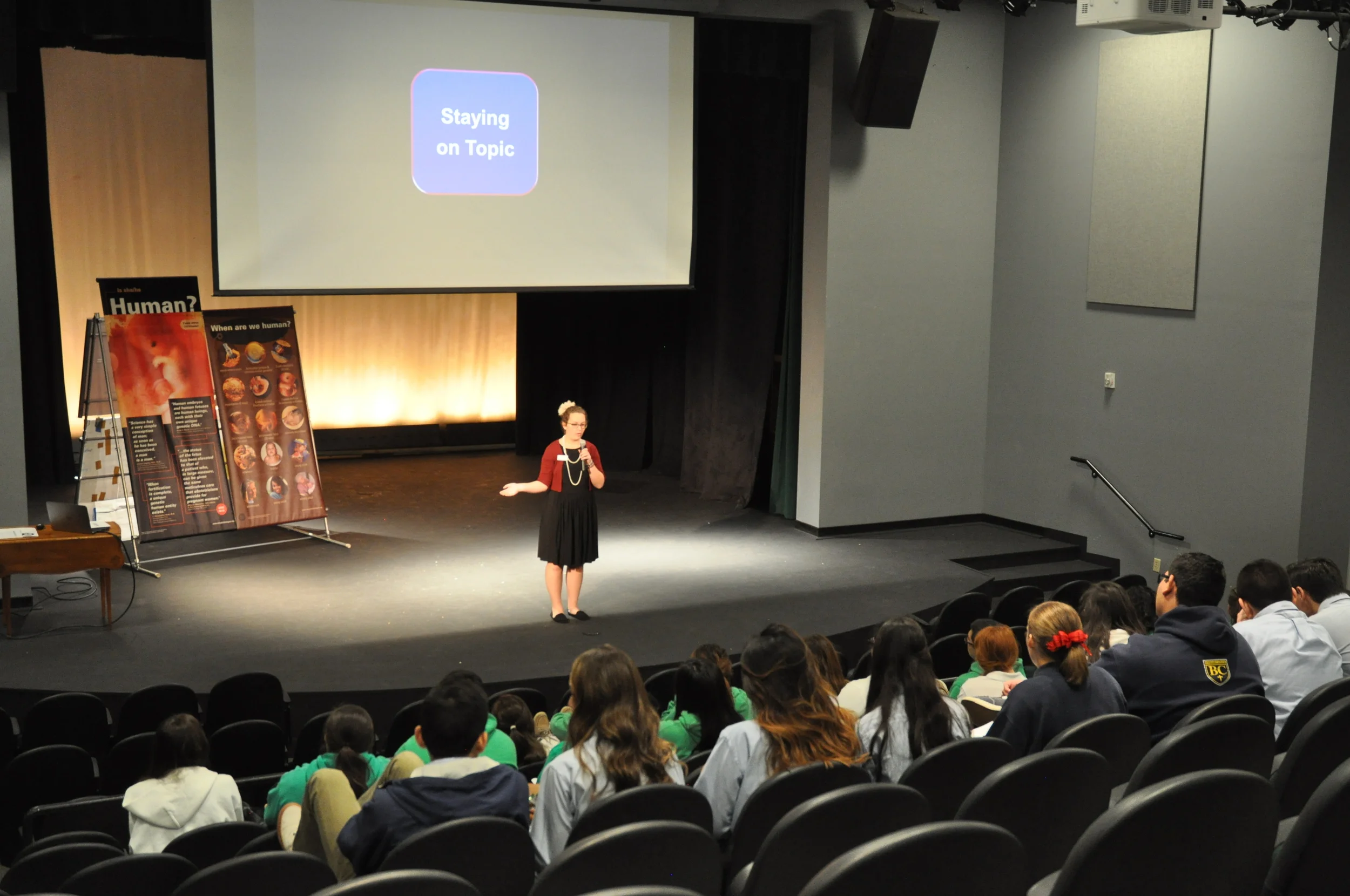
In February, I taught students in Arizona how to refocus a conversation about abortion onto the central question of “What is the unborn? The next week, these students participated in an outreach event at ASU. Not only was the weather gorgeous, but we met some wonderful people and had thought-provoking conversations.

Some of the other reasons people give for their pro-choice views, however, do not address that central question at all. Instead, these reasons assume that the unborn is not a valuable human being and that circumstances determine whether or not abortion is right or wrong.

When someone brings up a justification for abortion that does not address the question, “What is the unborn?” it is important to help him see that we must answer this question before we can move forward in our conversation. We must discuss what the unborn is because this is where our core disagreement lies. One conversational tool that helps people understand this more clearly is called “Trot Out the Toddler (TOTT)” from Scott Klusendorf of The Life Training Institute).

For example, earlier this month when “Rick”, a student at Arizona State University (ASU), claimed we need abortion because of overpopulation, I addressed this by using the four steps of TOTT that we teach in our Abortion: From Debate to Dialogue seminar: Agree, Apply, Ask Why, and Ah! Here is how I “Trotted Out the Toddler” in our conversation:

Rick: I just think that the world is overpopulated and that we need abortion to keep our population under control.

Me: I would agree that there are some parts of the world, like some cities in China, that are extremely overpopulated. Can we agree that we want people to be in healthy environments and have enough resources? [Acknowledge some aspect of Rick’s concern with which I can agree.]

Rick: Of course.

Me: So we are definitely on the same page about that. Let me ask you a question that doesn’t have to do with abortion. This example should also be something that is really clear to the both of us and I think it will help us in this conversation.

Rick: Okay.

Me: Let’s say that there is an orphanage of a thousand two-year-olds in one of those densely populated areas of China. The orphans don’t really have a healthy environment and resources are limited. Would you say that it would be right to kill these orphaned two-year-olds because of overpopulation? [Apply the situation raised to a toddler.]

Rick: No way!

Me: I agree with you. Why do you think it’s so clear that we can’t we kill a thousand two-year-olds? [Ask, “Why?” until Rick reveals that it’s wrong to kill two-year-olds because they are human beings.]

Rick: That’s mass murder! They are human beings.

Me: Ah! So, would you agree then, that if the unborn is a human being like a two-year-old, then it would be wrong to kill him even if the world is overpopulated? [The “Ah!” step of a conversation helps Rick see for himself that we must first address this question of “What is the unborn?” before we can move on in the conversation.]

Rick: I see what you are saying, but I don’t think the unborn is like a two-year-old.

Me: I see. Do you agree, though, that that’s the central question we need to resolve?

Rick: Sure.

And, suddenly, we were back on the topic of “What is the unborn?” Now the conversation could move forward and we could discuss more about our core disagreement. “Trot Out the Toddler” is one of my favorite conversational tools to both teach and use in dialogue. It is very helpful for ensuring that both I and the person I am talking with recognize what things we agree on, as well as what things still need to be discussed.

The way I’ve communicated this concept here has been heavily influenced by Justice For All’s Abortion: From Debate to Dialogue seminar. If you are able, I would love for you to attend a seminar and learn more!

What Do I Teach?

Part I: One Central Question Helps Change a Mind

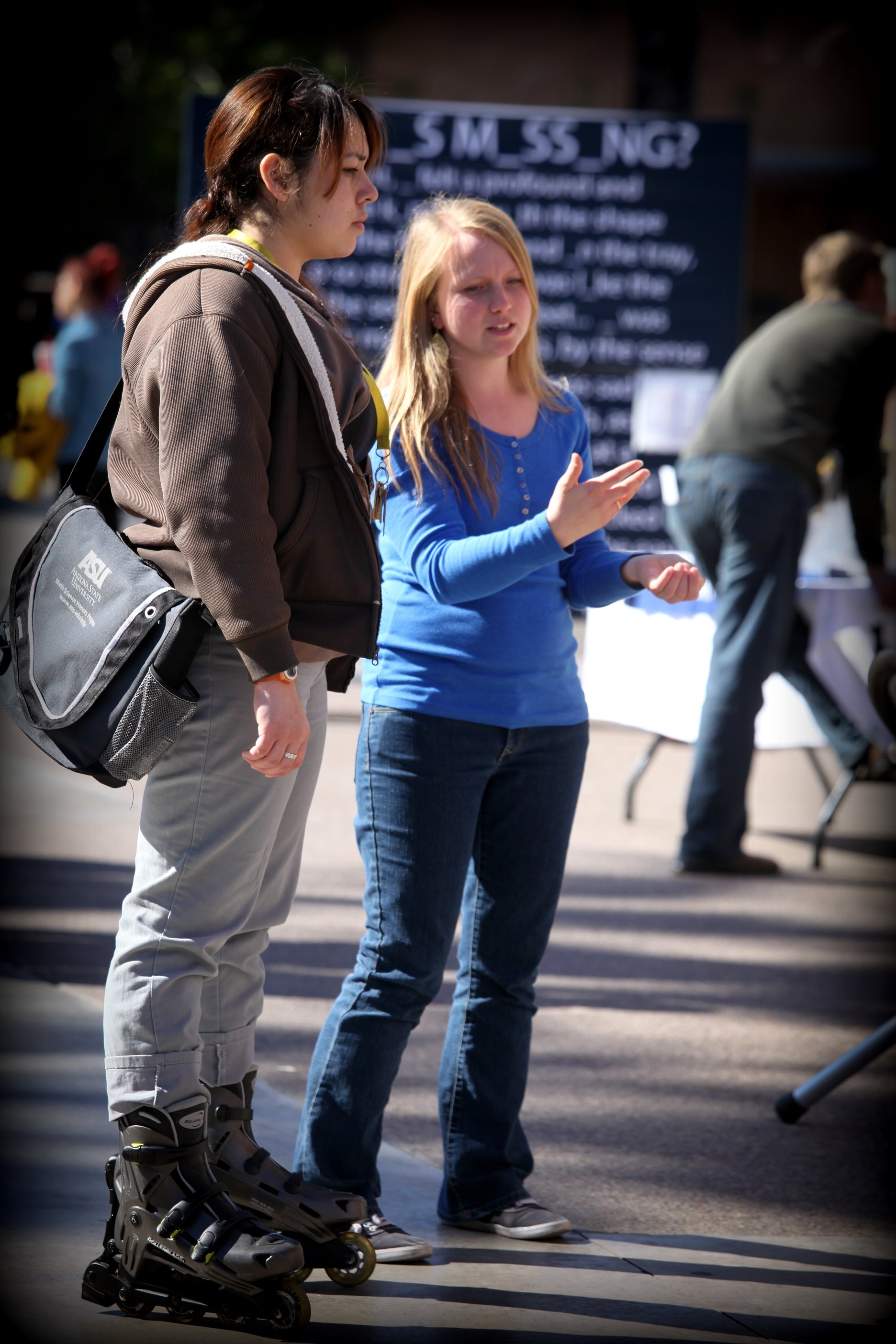
At Arizona State University (ASU) last month, I discussed the central question “What is the unborn?” with students like this young woman. See more snapshots of ASU conversations on the reverse.

She started out defending abortion because of the plight of those in poverty. In just minutes, she said, “We really need to resolve the question of what the unborn is.” From there, I was able to help her find an answer. What caused the change?

I noticed “Jamie,” a confident young student at the University of North Texas, when she rode her bike up to the edge of the Justice For All Exhibit. It took a few moments for me to decide if I would approach her. I’m so glad I did.

I asked Jamie what she thought about abortion. She told me openly, “Well, don’t get me wrong, I don’t like abortion. It just seems like difficult circumstances make it necessary. I’d say I’m pro-choice.”

“What sorts of circumstances concern you the most?” I asked. She replied, “There are so many things. What about poverty? How can we force women who have no money and no resources to have kids? And how can we force those kids into such horrible lives?”

Jamie was raising an important point, but I knew that the fact of poverty itself wouldn’t help us discover whether abortion is a good solution to poverty. The conversation that followed illustrated perfectly one of the things we teach JFA volunteers: With abortion, there’s one central question we need to answer before moving on to other questions. I follow four steps to help people discover for themselves how central this question is. We call this process Trot Out a Toddler.

Step 1: AGREE where possible.

Joanna: “Jamie, I agree with you that many women have so little money and so few resources that it is difficult for them to be mothers. We need to be more concerned about those in poverty.”

Step 2: APPLY the situation to a two-year-old.

Joanna: “But Jamie, imagine a woman who is living in extreme poverty and who absolutely cannot rear a child. She doesn’t even have enough money to feed herself. Imagine that this woman has a two-year-old. Should she be able to kill that two-year-old because their lives are so difficult?”

Jamie: “Of course not. She cannot kill a two-year-old!”

Joanna: “I agree. Of course she cannot kill her two-year-old. And I know that question sounds a little odd on its face...”

Step 3: ASK WHY the mother cannot kill the two-year-old.

Joanna: “… But let me ask you this: Why is it not okay to kill the two-year-old?”

Jamie: “Well, it’s not okay to kill the two-year-old because the two-year-old is a human being.”

Step 4: AH! (The light-bulb moment: Discovering the central question, “What is the unborn?”)

Joanna: “I agree. So it sounds like we don’t need to resolve the question of whether poverty matters. We agree that it certainly does. Rather, the question we need to resolve is, ‘What is the unborn?’ If the unborn is human like the two-year-old, then we can’t kill the unborn even because of poverty, right?”

Jamie looked at me and I could tell she was thinking hard. She replied,

Jamie: “That makes a lot of sense. I don’t know that much about when we become human, but it seems like that is the question we have to answer.”

Most people will agree that abortion kills something, but whether or not we can kill a living thing depends first on what it is. Some pro-choice arguments address this question, “What is it?” and argue that the unborn is not a valuable human being. But others, like Jamie’s, ignore the unborn completely. Although arguments like hers raise important concerns, they assume that the unborn is not valuable. The four-step Trot Out a Toddler process helped Jamie realize that she needed to focus on the central question, “What is the unborn?”

Jamie and I continued our conversation for a few more minutes, discussing the evidence for the biological humanity of the unborn. We also discussed why we can have confidence that the unborn human has the same basic human rights that you and I have. Toward the end of the conversation, I was excited to see the progress we had made:

Jamie: “You know, a lot of my friends are the ones protesting over there. [A number of pro-choice students had gathered with drums and signs to protest during the outreach.] But, I actually grew up in a Christian home, and my parents are pro-life. I don’t see eye-to-eye with my parents about a lot of things – for instance, I’m a lesbian – but I think I can agree with them about this issue. I think I can call myself pro-life now. I thought, by the way my friends talked, that you all were gonna shove anti-gay, anti woman rhetoric at me. But I actually enjoyed this conversation. I really appreciate the way you all are creating dialogue.”

I thanked her, and then she said something I’ll never forget:

Jamie: “I have a lot of friends who have had abortions. And Joanna, you can see the change in them after the procedure. They carry an undeniable emptiness, as if they’ve truly lost a person.”

And with that, she had to go to class.

Jamie’s barriers to being against abortion had been mainly social and cultural. She didn’t want to be identified with certain politically conservative views or certain “pro-life” people. The Trot Out a Toddler process was essential in our conversation because it helped her focus on the central question “What is the unborn?” Although this tool didn’t make the pro-life case for me, it helped Jamie and I agree about the question we needed to answer. It was just a short step from that point of agreement to Jamie's moment of realizing that abortion is wrong because it kills a valuable human being.

Toddlers Win Them Over

At JFA, we love giving pro-life advocates easy-to remember tools for keeping conversations about abortion focused and gracious. One of our favorites is “trotting out a toddler” (Scott Klusendorf, Life Training Institute).

Abortion is a very emotionally and psychologically complex issue for many people. But morally? It’s very simple: a lot of the noise surrounding abortion really boils down to just one question: “What is the unborn?”

This is because if abortion does not kill a human being, no justification for abortion is necessary. But if it does kill a human being, no justification for abortion is adequate.

I have found it very helpful in conversations to take Scott’s advice and trot out a toddler to show that this is the case.

There are four basic steps to trotting out a toddler:

1. Agree - Find areas of genuine agreement, without compromising your position.

2. Apply - Use their argument for abortion to justify killing a hypothetical two-year-old child.

3. Ask Why - When they reject this justification for killing a born child, ask them why. With few exceptions, they will respond that the argument doesn’t justify killing a born child, because the born child is a human being.

4. Ah! - The light bulb moment. (note: this is not an “A-ha! Gotcha!” moment - that would be prideful) Example: “Ah! Then the issue isn’t poverty, but ‘what is the unborn’, right? If the unborn are human beings, then shouldn’t we protect them like we do two-year olds?”

In the Dialogue box [below], you’ll read how this tool helped Raymond at Pasadena City College gain some important clarification about abortion last May when we went to his campus.

Note also how finding common ground with Raymond changed this potentially confrontational situation into a mutually respectful dialogue.


Raymond skateboarded up to the Exhibit and joined the conversation I was having with his two friends. Realizing I’m pro-life, he became defensive and condescending. But “trotting out the toddler” helped win him over.

Raymond (R): Women should have the right to choose to do with their own bodies what they want to! Especially women who are poor and can’t afford to raise kids - they need the right to abort.

Catherine (C): I appreciate your concern for women’s rights and for poor women.

At this, Raymond’s defenses came down a bit and he sat down with us.

C: But aren’t some choices wrong? Being a woman doesn’t gives me the right to kill a child if I can’t afford him, does it?

R: But if you guys don’t even care about born kids who are abused or living in poverty, then it’s inconsistent for you to care so much about unborn children!

C: Oh, absolutely!

R: Wait, what?

C: You’re right - if we didn’t care about born children who suffer, and only cared about unborn kids, that would be hypocritical. I agree!

R: Oh, okay. So then, why are you out here doing this?

C: Well, it’s because we do care about born children. The people on our team support and care for born children in lots of different ways. But wouldn’t it be inconsistent for us to advocate for the rights of born children, while ignoring the plight of unborn children?

R: Yeah, I guess that makes sense. I’ll give you that.

C: So, we agree on preventing children from being in poverty - that’s not the issue. The question is: does abortion prevent a child from living in poverty, or does it kill a child currently living in poverty - in his mothers’ womb? What is the unborn?