Internships

"I'm Going to Change My Vote."

Impact Report July 2026

In this Impact Report, we feature a story that trainer Kristine Hunerwadel shared recently in her May newsletter. Thank you for considering giving a special gift and praying for our team during our Summer Giving Challenge! -Steve Wagner Executive Director


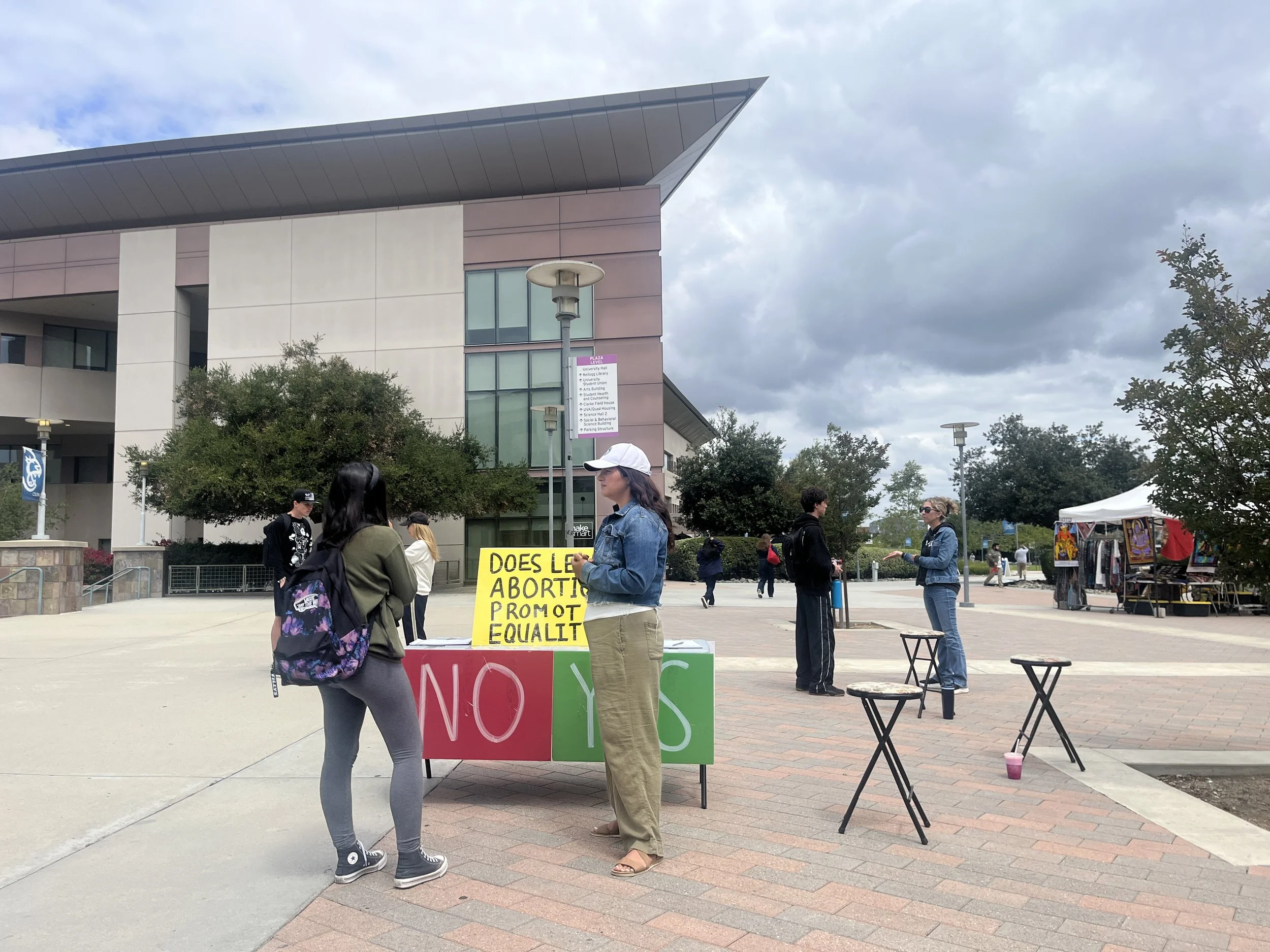
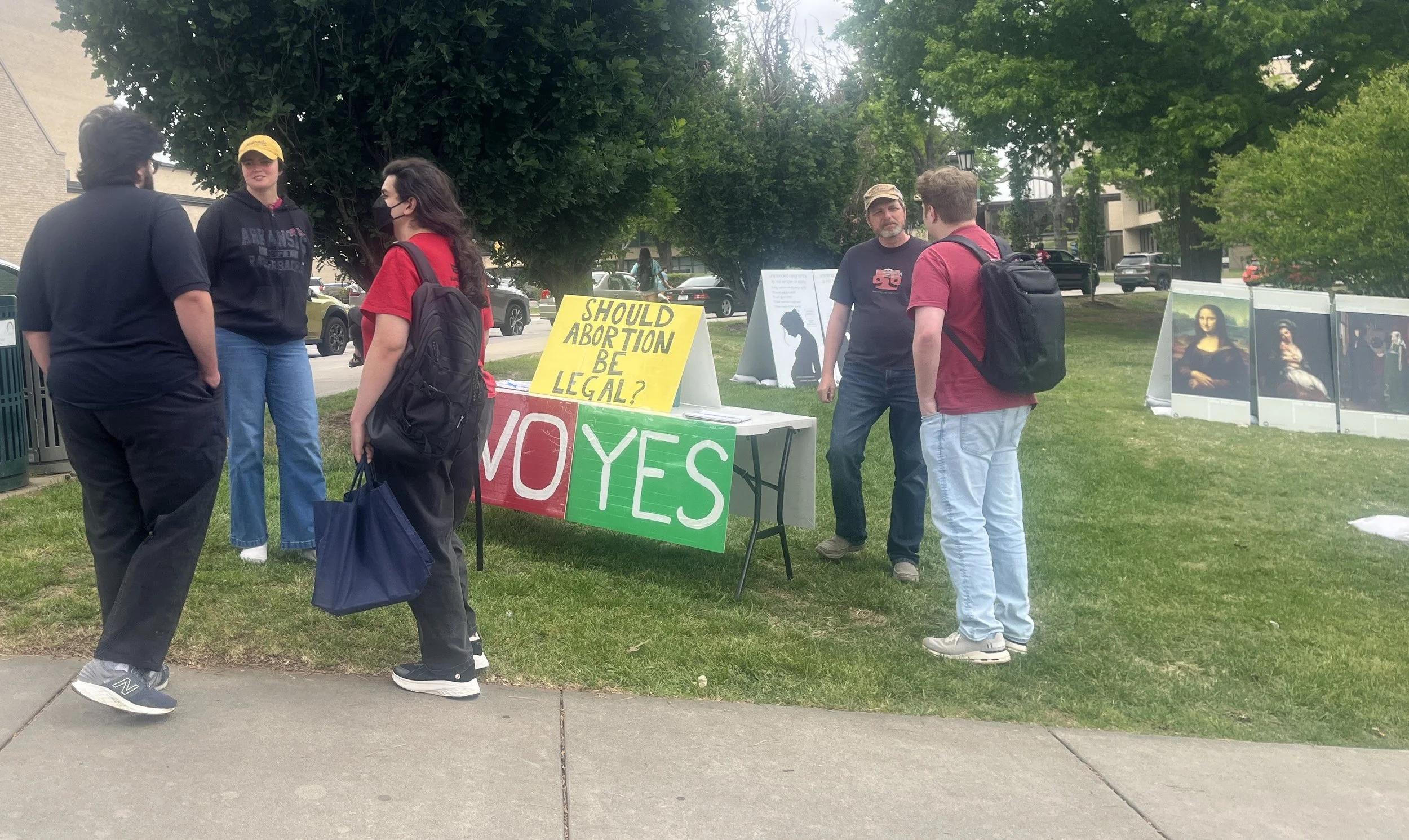
I was on campus at Adams State University in Alamosa, Colorado at the end of April, and at one point during our outreach event, I was sitting on the “No” side of our “Should Abortion Remain Legal?” poll table. I asked a female student nearby (who was getting ready to sign her name in the “No” notebook) about her thoughts on abortion. I’ll call her “Sarah.” Sarah paused, then realized what side she had started to sign, then crossed her name out and moved instead to the “Yes” side of the table, which was the side she thought she had been signing. My heart sank a bit while watching her switch sides, because I realized the conversation we were about to have was likely going to be different than the one I had expected. I waited while she wrote down her thoughts:

I don’t believe in abortion, and I think they are alive, but that’s my opinion. I am religious and do think it’s killing them, but it’s better to have a choice.

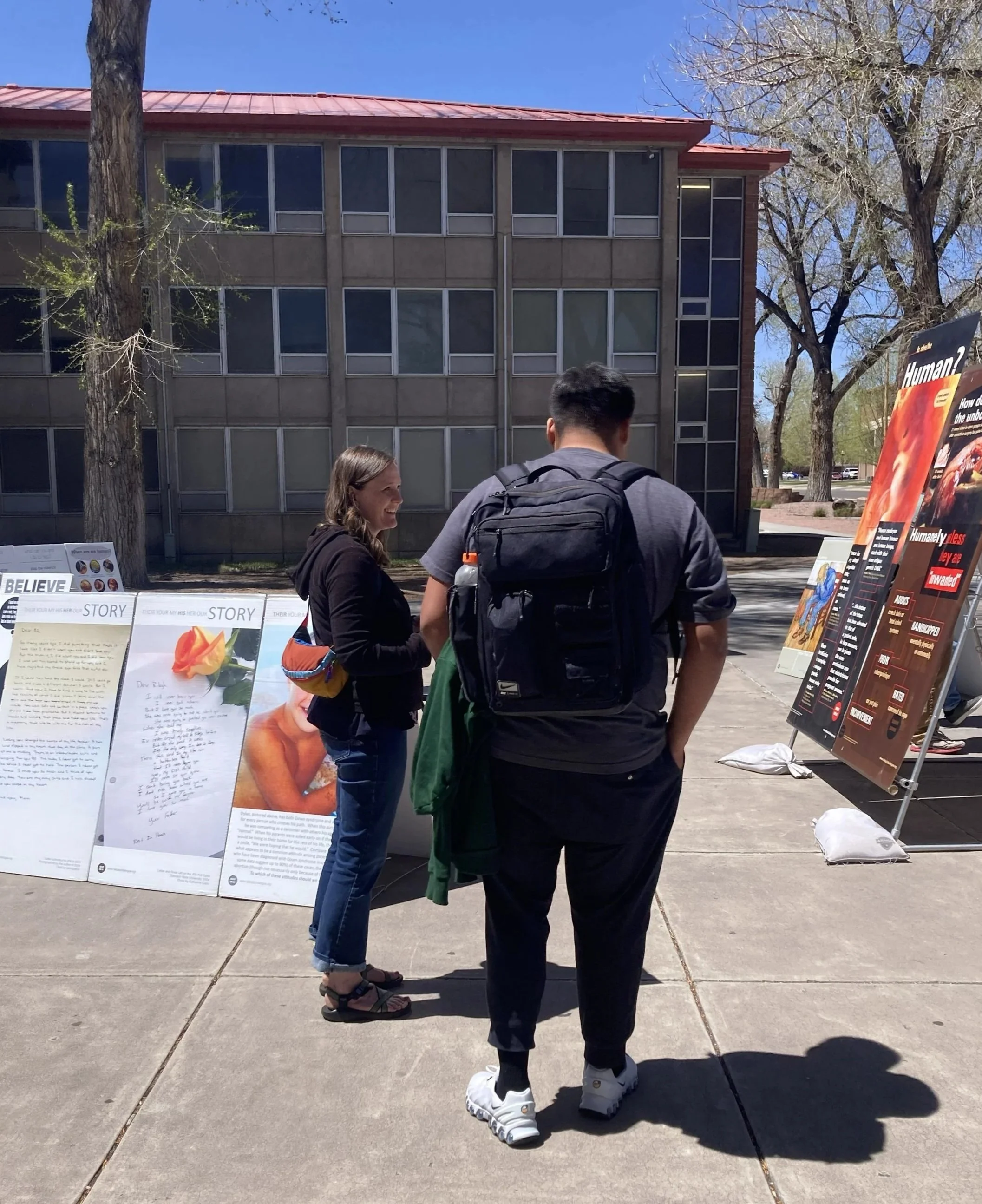
Kristine talks to a student at Adams State University in April.

Sarah and I proceeded to have a conversation about what she had written down. She said she was a Christian and that she thought abortion is wrong morally and that she doesn’t want women to choose it. Yet, she still thought they should have a choice. We discussed why that was the case, and why she personally didn’t believe in abortion. I then asked her a few questions about prenatal development and pointed out that the law protects infants from being hurt or killed. Then I asked her something like, “If the law protects human children after birth, and that’s because they are human beings, then why shouldn’t it protect them before birth as well, since they are human beings then, too?” We also talked about some difficult medical circumstances that can impact pregnant women, as well as various procedures and medications about which women need to have legal choices during pregnancy (related to things like ectopic pregnancies and miscarriages, for example). We discussed how essential treatment options in those settings (that are legal in all states currently, to my knowledge) differ from medications and procedures that are used to induce elective abortions. We also talked about the marvels of modern medicine, and Sarah was particularly intrigued to learn that currently medical specialists perform amazing in-utero surgeries at early gestational ages on very small prenatal children, who then continue to live and grow and develop inside their mothers until they are able to be delivered.

Sarah crossed out her "yes" response and changed her vote during the conversation with Kristine.

Overall, our conversation ended up being very pleasant, and Sarah at one point said, “I’m going to change my vote” and did so. We were able to talk a little about her journey in her faith and her current church, and I was able to introduce her to the campus ministry leader with whom we were working that day, as well as some students from his group. I was encouraged by her change of mind in the middle of our conversation, because conversations don’t often include an immediate and visible change of mind (and vote) like hers. In fact, I’ve been on staff with JFA for almost two years now, and Sarah was the first person who so definitively crossed out her initial answer during our conversation. It was clear from the turn of events in her case that the Lord had been working on molding and shaping her as she was growing in her faith already prior to our interaction that day, and that was exciting to see.

Another conversation I had that day, though, was with a male student I’ll call “Jack” who appeared to not budge at all in regards to his view on abortion (at least on the outside). He was adamant even that it was okay for women to take drugs while pregnant, even though they could harm the baby, and he also didn’t feel that stronger, more powerful adults owed care at all even to born infants. Drawing on JFA’s “It’s Her Body” series, I asked him something like, “For example, if you were hiking in a remote place and came across a defenseless infant on the path who was helpless and needed immediate care, and you had the means to help, and no one else was nearby who could do so, would you be obligated at all to care for the infant, at least until someone else could?” He responded that he would not be responsible to care for the baby at all, and that it would be fine to walk past it and do nothing. That was very disheartening. The next day, too, one of my conversations involved a woman I’ll call “Teresa” yelling off and on over the course of about an hour and a half while we were speaking together, to the point that the police were called by a professor who said her students inside one of the nearby buildings were having trouble focusing because of what was going on outdoors.

Like Jack, Teresa seemed from all appearances unwilling to change her mind, but she was willing to have a conversation, and I’m hopeful that seeds were planted in that conversation that God will use to change her heart one day. As we intend to do with every person we encounter on campus, our team paused that evening to pray for Teresa, Jack, Sarah, and other students we talked to during the outreach event. Will you please join us in praying for all of the students we’ve talked to this semester? Thank you!

-Kristine Hunerwadel, for the JFA Team


SUMMER GIVING CHALLENGE UPDATE

Meet Our Newest Intern: A recent graduate of Texas A&M, Eva is based in the Houston metro area near College Station. She is one of the interns supported by our Summer Giving Challenge. Please pray for Eva!

If you are one of the many who have responded to our Summer Giving Challenge, thank you! If you haven’t yet, please consider giving a special gift to one of four focus areas we’ve identified for the challenge. See our May 2026 letter and June 2026 letter for more information. If you’re currently giving to support the work of a JFA trainer, an extra gift this month helps us reach one of our goals! As always, call our office (316.683.6426) to reach any of our trainers to connect about the challenge.

For upcoming events, see jfa1.org/calendar. For recent stories and pictures, see jfa1.org/impact-quick-look.
Conversations with Helen and Lisa

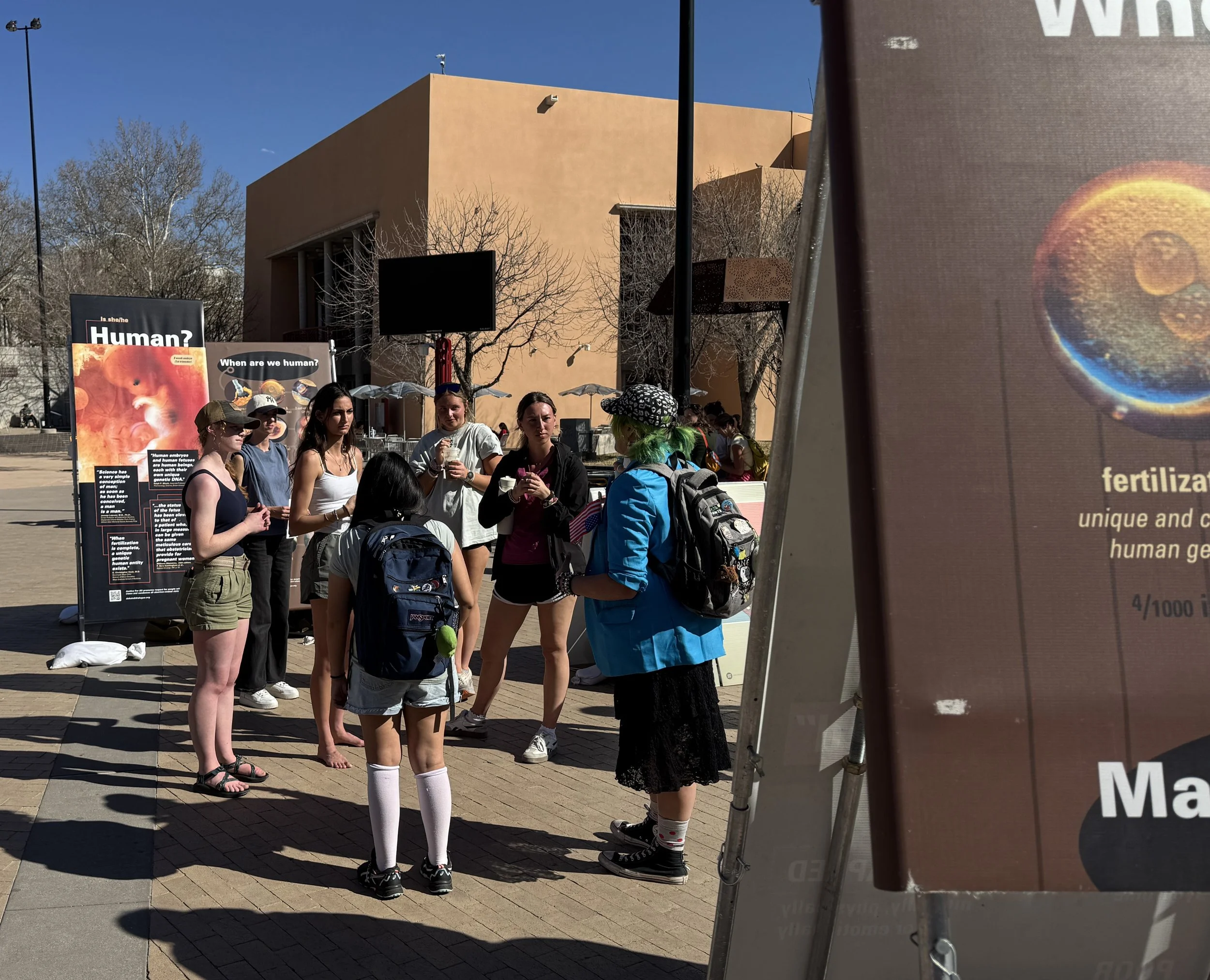
Thank you for supporting JFA’s work this year. We’ve been especially encouraged by the efforts of our fall 2023 interns, Seth and Catherine. In this Impact Report, you’ll read first-hand accounts of their conversations with “Helen” and “Lisa.” You can see both interns in action in the banner image and at the end of this post. Catherine will continue to volunteer with JFA in the coming months, and Seth is now raising support to work full-time as a Training Specialist. We thank God for these talented pro-life advocates, and we thank God for your partnership that has helped them make an impact.

You can still give a year-end gift at www.jfaweb.org/donate, or you can give a year-end gift by mail using the enclosed giving form and envelope. To receive a 2023 donation receipt, make sure gifts are submitted online or postmarked by December 31, 2023. Merry Christmas!

-Steve Wagner

IF WE HAD NOT GONE…

By Catherine Gimino, Fall 2023 Intern

“Helen” was unsure of her words, not just because we had interrupted her morning walk to class with an unexpected survey on abortion, but also because she was a foreign exchange student and new to speaking English. Despite this added difficulty with an already culturally-loaded topic, she was very willing to talk. I began by asking her questions to understand her view on abortion. Her view was that the unborn is not human until birth and so abortion at any stage is acceptable.

I walked her through what biology teaches us about the unborn, showing her that they are human beings starting at fertilization. I used Trot Out The Toddler and the Equal Rights Argument, tools taught by JFA to keep the conversation focused and to show that the unborn are human beings with an equal right to life. My attempts to clearly lay out the arguments were far from perfect. Despite feeling discouraged by my lack of eloquence, I kept going.

I eventually asked my coworker Kristina to jump in. She asked Helen, “Based off of what you’ve heard, do you think differently about abortion?” Helen responded saying that abortion should be illegal through all nine months and that she would support pro-life laws!

After Helen left, we debriefed the conversation. I told Kristina that I thought I could have explained things more clearly, but Kristina refocused me on the big picture: “That was a total mind change! By talking to you she went from thinking all abortion is okay to being against abortion. That is really awesome!” Then I realized something. If we had not gone out to WSU and asked Helen to participate in a JFA survey, her usual walk to class would have remained uninterrupted, and she would not have learned the truth about abortion that morning.

I trust God will bring a lot of fruit from this “interruption.”

A Conversation at Mankato

By Seth Wiesner, Fall 2023 Intern

In October I was doing outreach with the JFA team at Minnesota State University in Mankato. I started a conversation with a young woman named “Lisa.” She quickly became angry and began raising her voice. Suddenly she exclaimed, “I wish I had been aborted!”

Sensing that this issue was very personal to her, I took a step back from the questions I typically ask in order to challenge a person’s view. Instead I simply asked questions to try to understand her perspective. Asking questions about her beliefs not only helped me understand her position, but also demonstrated my care for her as a person. It gave me the opportunity to learn about her background, and this helped me discover the unspoken reasons that influenced her position.

Using this approach, we discussed her views on many different topics including the resurrection of Jesus. By the end of our conversation, she had softened her demeanor and her pro-choice views considerably. She accepted JFA’s “Invitation to Dialogue” brochure when I offered it to her and told me she was open to being pro-life. Thanks be to God. (See www.jfaweb.org/brochure to view and download the brochure.)

There is a great need for people to understand the truth about abortion. There are many out there, especially young adults, who haven’t been taught well and need someone to help them see how appalling abortion is. My conversation with Lisa is an example of how asking questions with an open heart and listening to understand can change the course of a conversation and lead people closer to the truth.

Summary Block
This block has no content yet. Items you add to the page connected to this block will display here.

Picture: How Two Minds Changed

November 2022 Impact Report

Before they step foot on campus, our interns and volunteers are trained to be faithful to God as his ambassadors, to leave the results of each conversation to him, and to be ready to not always see impact. Still, we hope their first experience can include some glimpses of change in the way people think, feel, and act regarding abortion. To support them, our veteran team members make it their highest priority to serve as mentors at our outreach events. In this Impact Report, JFA intern Hannah Cook shares the story of her first outreach day in August. Along the way, you’ll see the important role JFA trainers Mary and Tammy played in helping Hannah experience success. Thank you for praying for and supporting the work of our trainers, volunteers, and interns. God is changing the world through them, one conversation at a time. (See the JFA Blog for other recent stories of impact.) - Steve Wagner, Executive Director

I wanted to run away.

We had just about finished setting up our outreach displays at Wichita State University (WSU) when a girl gestured to our “Should Abortion Remain Legal?” poll table and said, “What are you guys doing here? I thought we already voted on this.” She was referring to the “Value Them Both” Amendment that had been soundly defeated in the Kansas Primary Election four weeks earlier. My foggy brain immediately snapped to attention as I sensed the edge in her voice. She was clearly irritated. I couldn’t tell if her condescending smile was a half-hearted attempt at cordiality or simply a way of insulting us further. In any case, I could tell that she was ready for a fight. One wrong word from us, and she would pounce. I felt adrenaline rush through my body as my heart began pounding. I looked to Mary Biegler who was standing next to me, hoping she would know what to say. I was thankful that she did.

Hannah (right) discusses the images in the JFA brochure with a student at Oklahoma State University in October 2022.

As Mary calmly began explaining that we were aiming to have productive conversations about abortion, I relaxed a little, hoping that the girl would have an open heart and mind. She did not. She questioned and challenged Mary at every turn, refusing to give an inch. At this point a guy walked up and joined the conversation. He listened for a few minutes, echoed the girl’s sentiments, and added his own challenges. We talked about bodily rights, the question of rape, and the central question, “What is the unborn?” No matter what we said, though, it was like trying to reason with brick walls. Nothing was getting through. Our arguments were cast aside and rejected. A mix of frustration, discouragement, and hopelessness swirled through me as I tried to keep up with the onslaught of objections being hurled at us. This was nothing like the life-changing encounters I had been reading about all week from other JFA interns and trainers. What happened to the nice open-minded discussions that left me feeling warm and fuzzy inside? At that moment, I wanted to flee the scene, drive the 19 hours back to my peaceful hometown in Idaho, and never talk to another pro-choice person again.

Well, it turned out that I was able to escape – not back to Idaho but at least out of that conversation. Someone asked for directions, and I stepped away to help her. A little while later, I noticed three guys standing nearby listening to a conversation at the outreach. They seemed interested in the topic, so I asked if they had any thoughts about abortion. They told me that they were from Zimbabwe and that abortion really isn’t talked about there. Their names were Chimdi, Denzel, and Bryan.

Denzel and Bryan said they were personally pro-life but that abortion should still be legal. Chimdi didn’t think it should be legal. When I asked Denzel and Bryan if they thought there should be any restrictions on abortion, Bryan told me that he thought the cut-off should be five months gestation. “Why did you pick that specific point?” I asked. He replied, “Because by then they have arms and legs and everything.”

When I heard this, I knew that he needed to see pictures of fetal development because the features he was describing appear so much earlier than five months. When I showed Bryan and the others that arms and legs are clearly present at seven weeks post-fertilization, they were all shocked. Immediately Bryan switched his cut-off point to three months gestation. I was amazed at such quick progress. It showed me the power of pictures. We talked some more, and I trotted out the toddler to help us focus on the question, “What is the unborn?” Even so, they still held pretty firmly to the belief that a woman should have a right to choose. Meanwhile, Tammy Cook had come up and was listening to our conversation. She later told me that she was there to be a support, and she wasn’t planning to say anything unless I asked her.

The conversation had been productive so far, but I wasn’t sure how to proceed. I turned to Tammy and asked what she thought. She asked all of us to imagine two buckets filled with different choices. The first bucket contains personal preferences like which foods you eat, what college you attend, and with whom you choose to spend time. The second bucket contains choices that harm people – choices like rape, child abuse, and murder. She noted that there should be legal restrictions on the second bucket of choices because those particular choices harm other human beings. She then asked which bucket abortion belonged in. They all said that it belonged in the second bucket. I was amazed and delighted – even more progress! (For more about the “Two Buckets” analogy, see www.jfaweb.org/two-buckets.)

Tammy’s “Two Buckets” analogy had definitely put us on the right track, but Bryan was still resistant. He said that the reason people don’t care about abortion in the same way that they would care about a toddler being killed is because they can’t see abortion. He almost said it in a way that justified his own position about abortion – suggesting that he too thought it was okay because he couldn’t see it. I suddenly knew what I needed to say. I asked the three of them if they had heard about Emmett Till, the black boy who was murdered for allegedly “whistling at a white woman” in the South in the 1950’s. I was a little surprised when they nodded and said that yes, they knew of him. (For a good introduction to the story, watch the trailer of the newly-released movie, Till.) After briefly recapping the story, I was able to explain that when Emmett’s mother physically opened the casket of her maimed and disfigured son, she metaphorically opened the casket on racism, and the whole world saw racism for the evil and horrific thing that it was. No longer was racism hidden from public view – it was on full display and could not so easily be denied or minimized. Then I said, “I actually have some pictures of the results of abortion with me. Are you willing to look at them?” Denzel was the first to view the brochure, followed by Chimdi. Bryan refused to look, but the connection between Emmett Till and abortion was sinking in.

The next thing I knew they were all agreeing that abortion should not be legal at any point. I was overjoyed. One conversation had resulted in a complete change of heart and mind for these students. Regardless of whether people change their mind, it’s still worthwhile to have conversations with them, but it is such a gift when we do get to see change take place. It was a great encouragement as I continued having conversations with other students who were not so quick to change.

I also realize that if I had chosen to run away after that initial conversation, I never would have received the blessing of witnessing such a profound transformation of heart and mind in Denzel and Bryan. I thank God for helping me to continue to be faithful even in the midst of discouragement.

– Hannah Cook, for the JFA Team


Make Your Own Impact by Giving a Year-End Gift

As you consider your year-end giving, please consider giving generously to JFA to help us train more Christians to change more hearts and minds about abortion in 2023. With various state ballot initiatives strengthening abortion rights following the Supreme Court’s Dobbs decision, it’s especially important that we continue our work of changing hearts and minds, one person at a time. Even in the states where unborn children now have legal protection, we see hearts and minds wavering, especially when no one has come alongside to help each person think things through. We’re encouraged, though, because we know that one person can change the world. Each person we train and each person we engage in dialogue can change the world for an unborn child, and each child allowed to live can in turn change the world for others. Above all these, we believe God is the one who really changes minds, heals hearts, and changes the world. Please partner with us as we seek to humbly serve our great God in this work in 2023. You can give online or send a check using the information on our “Mail a Gift” page. Learn more about JFA’s vision and needs for 2023 at our “Invest in JFA” page. Or, call me directly at 316-683-6426 to discuss! - Steve Wagner, Executive Director


Mary Jumped Right In!

“Naturally gifted at public speaking, Mary quickly learns the material she will be presenting to pro-life advocates while also allowing her personality to bring joy to the conversation, even in the midst of discussing the heavy subject of abortion. Teaching Mary to present JFA material has been a delightful process for me.” - Rebecca Hotovy, JFA Speaking Coach

This was the perfect semester for Mary St. Hilaire to make her entrance into the JFA community as an intern. Given the COVID-19 shutdown, that may sound odd, but God knew the type of people we would need for this particular season.

Mary was eager to finally start the internship for which she’d been preparing. In anticipation, she said,

“Justice For All (JFA) is a group that I have known about and loved for several years now because of the way they approach the pro-life movement. JFA's goal is to educate people, specifically college students, on the reality of abortion and the humanity of the unborn through respectful dialogue. JFA's approach is not one of hate, judgment, or condescension, but of love, understanding, and openness. This is what attracted me to them. My passion for the pro-life movement put in me the urge to do more to save the lives of the innocent, and JFA is truly the perfect fit for me.”

We soon realized she was right, and that she was also a great fit for us!

I had the privilege in 2019 of following up with Mary several times about her desire to impact the injustice of abortion. Through our phone calls, her application, and the interview process it became clear that Mary genuinely wanted to help, was willing to work hard, and would enhance our team. She didn’t disappoint.

Hailing from the Lincoln, Nebraska area, Mary took her faith, her unbending pro-life convictions, her work ethic, her joy, and her sense of humor to Wichita, Kansas and didn’t look back. We could see that her family had prepared and encouraged her in some amazing ways!

Mary started as an intern in late January and quite quickly jumped into her two main tasks — creating conversations on college campuses (becoming a trusted advocate on our team) and learning our speaking material well enough to be able to contribute to our training events within weeks.

This semester will always be remembered for the impact of COVID-19 on our society, the shutdown of schools, the cancelling of events, and how it pushed our ministry to enhance our outreach and training tools online. It changed our plans, but it didn’t ruin our mission. This cultural moment has allowed us to take new chances, learn new things, and it was actually the perfect semester for Mary to start with us.

We are so thankful for the way our schedule worked out, abnormally packed for February. Mary started the semester off with a total of 11 outreach days and 4 interactive training events. She also helped in our office and learned speaking parts, making for a wild six weeks. If the schedule had been lighter, she would have had far less practice by the time the COVID-19 shutdown happened. Instead, she emerged a much stronger advocate through events in Denton, Albuquerque, San Antonio, and Dallas. By the time she completed our spring break mission trip at UT Dallas (March 9-11), Mary had also successfully contributed to our training seminars by delivering our “One Central Question” section (aimed at simplifying the abortion conversation), and she did a great job. She was polished, energetic, clear, and enjoyable to watch.

The Dallas trip helped all aspects of Mary’s job come together in a dynamic way. She helped with the speaking and brought a good amount of experience to outreach conversations there at UT Dallas. The mission trip team had enjoyable team building experiences together as well.

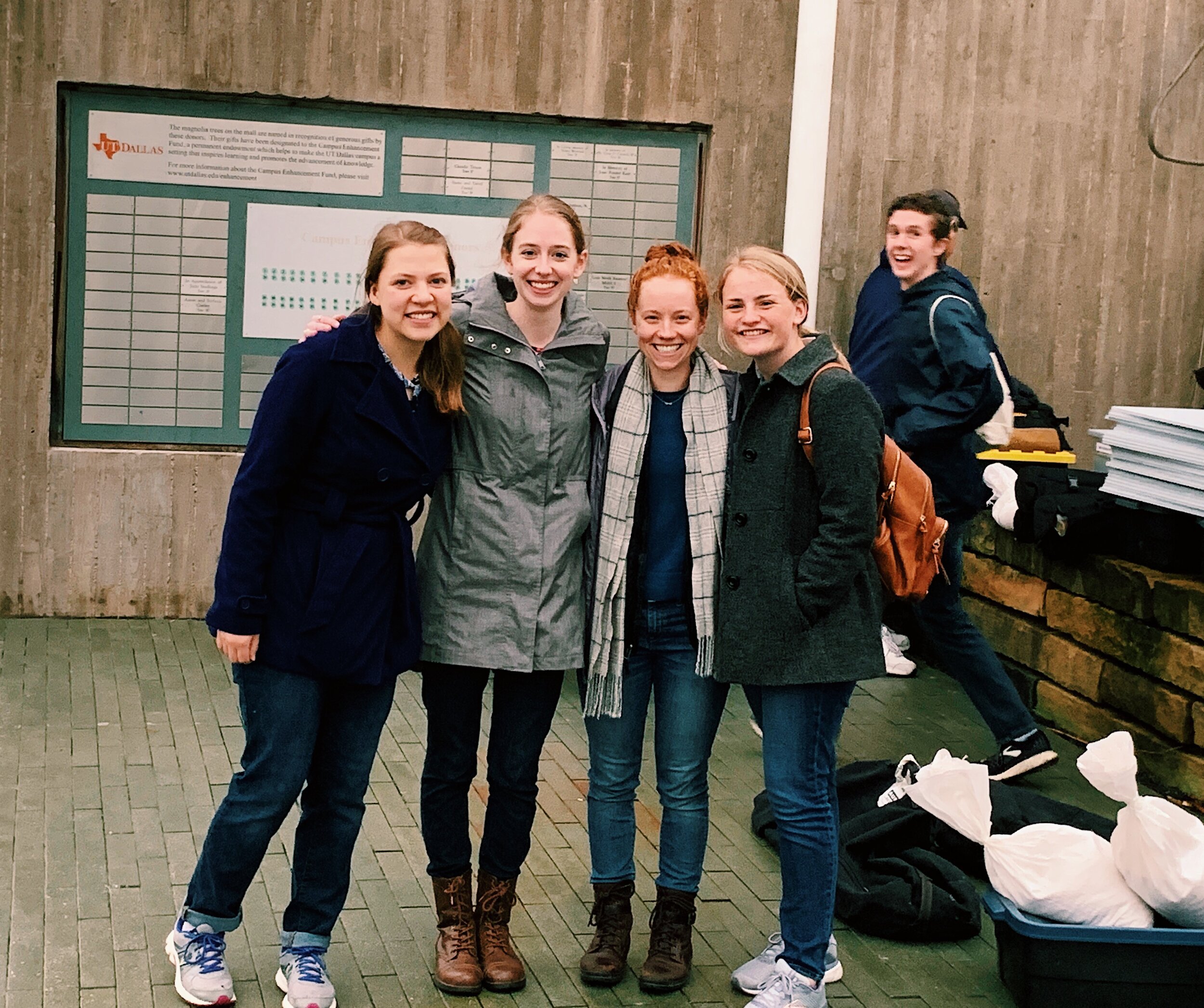
Mary in a conversation at UT Dallas, the last location where we held an outreach event before the COVID-19 crisis caused us all to change our plans.

Posting in March about her internship experience, Mary said,

“If I had to choose the single most important thing I’ve gained from interning with Justice For All these past two months it would most definitely be a new kind of love for all humans. In conversing with so many people from various races, religions, states, and even countries, getting to know them on a personal level, sharing my beliefs with them, and searching for the truth alongside of them, I have come to realize that my love does not have to be limited to only those with whom I share the same views. I knew this in my head, but until I actually participated in outreach, I didn’t know it in my heart. Through respectful dialogue I have been able to actually understand opposite viewpoints and beliefs for the first time in a totally new way. I have been able to find common ground and mutual interests with people I previously would’ve thought I could never talk to, and I have been able to positively impact students I thought would never want to hear my view.

“Each conversation I’ve had has brought me closer to an understanding of what Jesus’ words “Love your neighbor” truly mean. He didn’t mean “just be nice to your neighbor and put up with them.” No. He wants us to unconditionally love the people around us, despite their beliefs, their backgrounds, or their lifestyles. He wants us to take time to get to know them, listen to them, pray for them, help them, and love them as he loves us—without exception. Every single person I’ve talked to on campus holds a special place in my heart. I loved getting to know all of them, telling them about myself, and discussing the hard topic of abortion as well as other important issues with them. I think about them individually all the time, and I pray for them on a regular basis. I love them, not because we believe the same things, we’re from the same place, or raised the same way, but simply because they are children of God.

“I used to be scared to meet people who I disagree with spiritually, politically, or morally. Now, I jump at the chance to meet people of different beliefs! I find it intriguing and exciting to learn new religious, political, or moral views, and I love being able to share my beliefs and passions with them. For me, there is nothing more rewarding than meeting, knowing, and loving the people I meet through this work. JFA is by far one of the greatest blessings of my life, and I’m looking forward to the rest of my internship here!”

After our trip in early March, we decided to limit travel, and then within a week or so most schools were shut down anyway. Still, this didn’t shut down Mary’s internship. To the contrary, she pushed ahead with her speaking parts, learning several more sections of our seminar this past month. She is ready to assist with online trainings in the coming months and at in-person events when those return. Just last week, Mary was a significant contributor for our webinar. See upcoming webinars at JFA’s Calendar Page.

Mary has also been instrumental in helping us pivot during this time by being more active online with Instagram, Facebook, and other social media platforms. She’s worked hard to connect with pro-choice folks and to encourage pro-life students, and along the way she has encouraged the rest of our staff with some specific skills she brings.

VIDEO: Why a JFA Internship?

Above, JFA intern Grace Fontenot shares what sparked her interest in a JFA internship and discusses what the experience has been like so far.  Take a look!

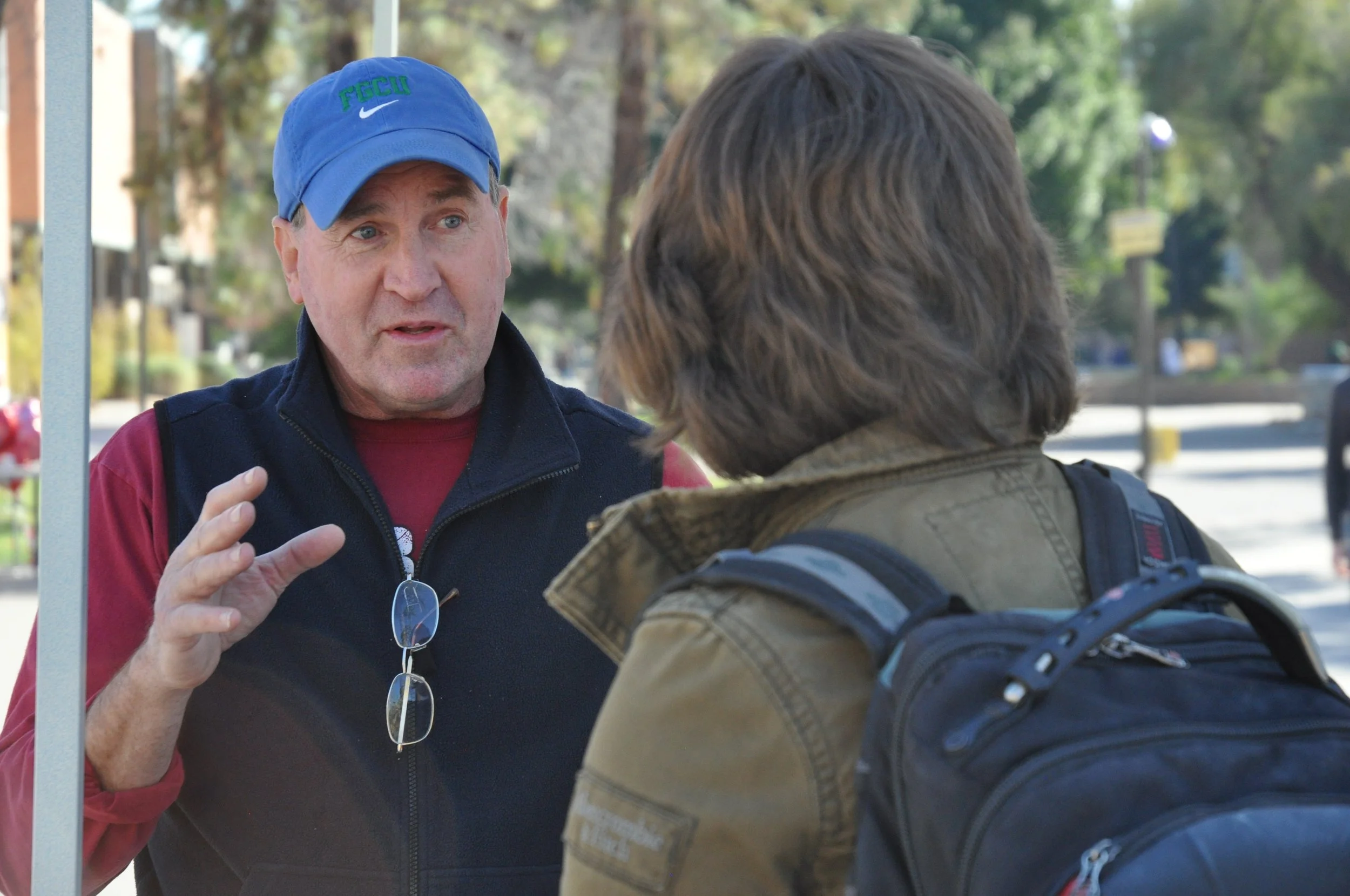
Grace Fontenot (see video) interacts with a student at Fort Hays State University in September 2016. Support Grace's JFA internship by clicking here.

Grace Fontenot (see video) interacts with a student at Fort Hays State University in September 2016. Support Grace's JFA internship by clicking here.

Note:  Special thanks to Genesis Media Solutions for the excellent production on this video.

Quick Links: